
NEWS DETAIL
PEMF vs TENS vs EMS: Mechanism, Waveform, and Regulation Compared
Technically reviewed by Frank Zhao, R&D / Regulatory Affairs, BioLifeTech — Professional Manufacturer & R&D Team, Since 2017. Last reviewed: 2026.11.20
Conflict of interest disclosure. BioLifeTech manufactures PEMF and infrared therapy equipment. This page compares physical mechanisms, regulatory classifications and published research. It does not recommend any technology, device or protocol for any condition.
Scope note. This page covers engineering specifications and published parameter usage. It makes no claims about health outcomes and does not recommend parameters for any condition. Follow the Instructions for Use supplied with your specific device.
Read our Medical Disclaimer.
Quick Answer: What is the difference between PEMF, TENS, and EMS?
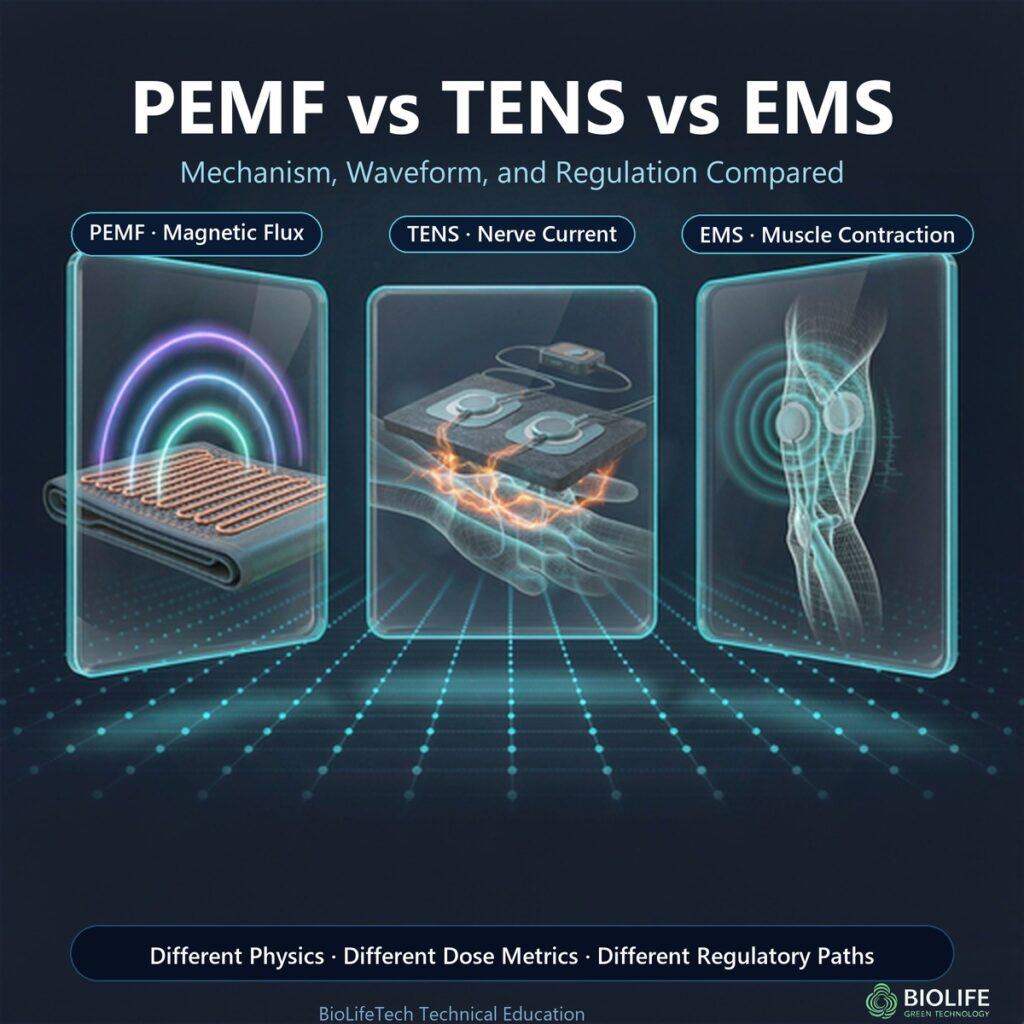
PEMF delivers a time-varying magnetic field that induces weak electric fields inside tissue without skin contact. TENS and EMS both pass current through surface electrodes, but target different tissue: TENS is classified for pain relief via sensory nerves, EMS for repeated muscle contraction via motor units. The three use different physical quantities, different waveforms, and different regulatory pathways, and no head-to-head trial has compared them as substitutes.
- PEMF — magnetic flux, contactless, measured in tesla or gauss
- TENS — charge delivered to sensory nerves, measured in milliamps and pulse width
- EMS — charge delivered to motor units, produces visible contraction
- Not interchangeable — different dose metrics, different regulatory classes
1. Three technologies, three physical channels
Most PEMF vs TENS comparisons start by lining up numbers that share a name and nothing else. The phrase “electrotherapy” gets applied to all three, and that is where the confusion starts. As a result, a purchasing manager comparing quotes, or a user reading two product pages, will see the same vocabulary (frequency, intensity, session length) attached to quantities that cannot be compared.
The distinction is not marketing. It is physical.
1.1 PEMF delivers magnetic flux
A PEMF system drives current through a coil. The coil then generates a magnetic field that changes over time, and that changing field induces an electric field in conductive tissue according to Faraday’s law. Nothing needs to touch the skin. In fact, the field passes through clothing, bandages and casts without measurable attenuation at these frequencies.
What the tissue “sees” is a small induced electric field, typically on the order of millivolts per centimetre. The device controls the magnetic flux density, the pulse shape and the repetition rate. Together, those three parameters define the exposure.
For the engineering background on coil geometry and field distribution, see our guide to PEMF coils and field parameters.
1.2 TENS delivers charge to sensory nerves
TENS uses two or more electrodes on intact skin. Current flows between them, and the current density falls off with distance from the electrode edges. The relevant dose is charge per pulse: current multiplied by pulse duration.
The mechanistic rationale most often cited is gate control theory: large-diameter afferent fibres carry the signal faster than small-diameter nociceptive fibres, and the spinal cord gates the input. That is a theory of pain modulation. It explains why the technique might work. However, it says nothing about whether it does in a given patient.
1.3 EMS delivers charge to motor units
EMS also uses surface electrodes. The difference is target and current amplitude. Because motor neurons have higher thresholds than sensory fibres, EMS runs at higher current, longer pulse widths, and burst patterns that allow muscle to relax between contractions.
The output is mechanical, not just electrical. A working EMS session produces visible contraction. That gives the operator a verification signal that PEMF and TENS do not offer. You can see whether the motor unit fired.
2. What the physics actually differs in
The table below is the one worth keeping. It maps each technology to the quantity a test house would actually measure.
| Dimension | PEMF | TENS | EMS |
|---|---|---|---|
| Carrier | Magnetic field (contactless) | Electric current (skin electrodes) | Electric current (skin electrodes) |
| Primary dose metric | Magnetic flux density, mT or gauss | Charge per pulse, µC; current, mA | Charge per pulse, µC; current, mA |
| Typical flux / current | 34 µT–2 mT (0.34–20 G) for mats | 10–60 mA | 20–80 mA |
| Pulse width | Defined by coil drive waveform | 50–250 µs | 200–400 µs |
| Frequency range | 0.5–100 Hz typical; up to kHz in some systems | 1–150 Hz | 20–80 Hz burst |
| Sensation during use | Usually none; some report warmth or tingling | Tingling, often described as “buzzing” | Visible muscle contraction |
| Regulatory class (US) | Varies by claim; see §4 | Class II, 21 CFR 882.5890 | Class II, 21 CFR 890.5850 |
Two rows in that table cause most of the specification disputes we see at trade shows: flux versus current, and “frequency” meaning two different things. Each one deserves its own subsection.
2.1 Magnetic flux density in a PEMF coil
For a solenoid of n turns per metre carrying current I, the flux density in the core is:
B = μ₀ · μᵣ · n · I
with μ₀ = 4π × 10⁻⁷ H/m and μᵣ ≈ 1 for air. A mat coil is not an ideal solenoid. It is flat, wide and often multi-coil, so the figure a supplier quotes is normally a measured value at a stated point, usually the centre of the mat surface.
That qualifier matters. For example, “50 gauss” without a measurement position is not a specification. Field strength at the mat surface, at 5 cm above it, and at the body’s centre line can differ by an order of magnitude.
2.2 Charge per pulse in TENS and EMS
For a rectangular pulse, charge per pulse is simply:
Q = I × t
A 20 mA pulse of 200 µs delivers 4 µC. Charge density matters more than total charge, because current spreads over the electrode area: 4 µC through 20 cm² is 0.2 µC/cm², and the same charge through 4 cm² is five times that density.
Consequently, electrode size changes the feel of a TENS session at the same displayed intensity. By the same logic, comparing “intensity” numbers between two TENS devices tells you almost nothing.
2.3 Why the units are not interchangeable
A 2 mT PEMF mat and a 30 mA TENS unit are not “stronger” or “weaker” than each other. They act on different physical quantities in different tissue compartments. Therefore, any comparison table that puts them on one axis is either confused or selling something.
Some parameters do transfer between the two: session duration, treatment frequency per week, and the fact that both are under-dosed in most published protocols. Others do not: amplitude, waveform, and anything measured in gauss versus milliamps.
2.4 Reading a real specification sheet: a worked example
To make the difference concrete, here is how the same logic applies to a typical datasheet. Suppose a supplier lists the following for a PEMF mat: “frequency 1–99 Hz, intensity 3 gauss, timer 10–60 min”. Suppose, meanwhile, a TENS listing reads: “frequency 2–120 Hz, intensity 0–60 mA, pulse width 50–300 µs”.
On paper the two look comparable. In practice, the PEMF entry is missing four things: the pulse shape behind that frequency range, the measurement position for the 3 gauss figure, the rise time of each pulse, and the coil layout that produced it. Without those, the number could describe anything from a strong localised field at the coil surface to a weak uniform field across the whole mat, and both products could honestly carry the same line of text.
The TENS entry, by contrast, is nearly complete. Because TENS output is defined at the electrode and the user can feel it, the three listed numbers (rate, amplitude, pulse width) pin down the exposure almost fully. Additionally, charge per pulse is derivable from the last two: 60 mA for 300 µs is 18 µC, a figure a clinician can compare directly against published protocols.
That asymmetry is the practical takeaway of this whole section. Therefore, when a buyer asks “can I compare these two datasheets?”, the honest answer is: only after the PEMF line has been expanded into pulse shape, measurement position and coil geometry. Until then, the two lists share a vocabulary and nothing else, which is exactly where this article started.
3. Waveform and frequency: where the confusion starts
All three technologies use the word “frequency”, and it means different things each time.
PEMF frequency is the repetition rate of the magnetic pulse train: how many pulses per second. Within each pulse, the rise time and shape determine the induced electric field. A 10 Hz sine burst and a 10 Hz square burst are the same repetition rate and completely different exposures. We cover the three common drive shapes in the sine wave, square wave and sawtooth entries of our waveform series.
TENS frequency is the pulse repetition rate in Hz, and the conventional split is low (1–10 Hz), high (50–150 Hz), and burst or modulated patterns that sweep between the two. Whether high or low frequency is preferable is a clinical question. Meanwhile, the Cochrane overview in §5 found the evidence too weak to answer it.
EMS frequency is usually expressed as a burst frequency with an on/off duty cycle, for example 50 Hz for 5 seconds, then off for 10. The duty cycle controls fatigue. Ignoring it is the single most common EMS programming error, because continuous contraction at high intensity exhausts the muscle within a couple of minutes.
One practical consequence for buyers: a supplier datasheet that lists “frequency: 1–100 Hz” for a PEMF mat is telling you the pulse repetition range. It is not telling you the pulse width, rise time, flux density, or coil geometry. In other words, those four numbers, plus the measurement position, are what actually define the product.
4. Regulatory status in the US and EU
Regulatory class follows intended use, not technology. This is the section most often skipped in comparison articles. However, it is the section that decides whether a product can legally be sold with a therapeutic claim.
| Market | PEMF | TENS | EMS |
|---|---|---|---|
| US class | Depends on claim: cleared 510(k) devices exist for specific bone-healing indications; general wellness mats carry no therapeutic clearance | Class II, 21 CFR 882.5890 | Class II, 21 CFR 890.5850 |
| US route | 510(k) with clinical data, or no medical claim at all | 510(k); many models cleared for OTC sale | 510(k); prescription and OTC variants |
| EU | MDR Class IIa or higher for therapeutic claims; wellness positioning outside MDR | MDR Class IIa | MDR Class IIa |
| Claim language | Engineering and comfort language only, unless cleared | “Relief of pain” only within cleared indications | “Muscle contraction” / “muscle conditioning” |
The US TENS definition is narrow and worth quoting, because it constrains labelling more than most suppliers realise: “a device used to apply an electrical current to electrodes on a patient’s skin to treat pain” (21 CFR 882.5890(a), Class II).
The EMS definition is similarly specific: “an electrically powered device intended for medical purposes that repeatedly contracts muscles by passing electrical currents through electrodes contacting the affected body area” (21 CFR 890.5850(a), Class II).
For PEMF there is no single equivalent paragraph, and that is the point. A mat sold for relaxation and general comfort sits outside device claims. In contrast, a PEMF device sold for bone healing has been through 510(k) review with clinical evidence for that indication. The two are not the same product category wearing different labels.
Our own position, stated plainly: BioLifeTech PEMF mats are FDA Registered and classified 510(k) Exempt (Class I / Class II as regulated). Registration is not clearance, and it is not an endorsement of any therapeutic effect. We explain the distinction in more depth in Is PEMF FDA Approved? and in the CE vs FDA vs FCC certification guide.
5. What the evidence looks like: PEMF vs TENS vs EMS
Three different evidence bases, three different quality levels. Reading them side by side is more useful than reading any single trial.
| Technology | Best available synthesis | What it concluded | Confidence |
|---|---|---|---|
| PEMF (whole-body mats) | Hug & Röösli 2012, systematic review of 11 sham-controlled double-blind trials | Evidence for therapeutic effects insufficient; no acute adverse effects reported; long-term effects unstudied | Low |
| PEMF (osteoarthritis) | Cianni et al. 2024, systematic review of 17 RCTs, 1,197 patients | Reported ~60% reduction in VAS and ~42% improvement in WOMAC; device heterogeneity prevents inference about any specific device | Low to moderate |
| TENS (chronic pain) | Gibson et al. 2019, Cochrane overview of reviews | Evidence quality very low; cannot conclude TENS is beneficial or harmful for chronic pain | Very low |
| EMS (muscle function) | Multiple small trials in rehabilitation populations | Strength and function gains reported in specific post-operative and immobilisation contexts | Low to moderate, population-specific |
Two honest observations about that table.
First, the PEMF evidence is not uniformly negative, and it is not uniformly positive. The 2012 review found the whole-body mat category unproven. In contrast, the 2024 review found consistent pain-score improvements across osteoarthritis trials. Both can be true, because they asked different questions of different study sets. Additionally, the 2024 review explicitly notes that device variety and protocol variety prevent generalisation from the pooled result to any single product.
Second, no randomised trial has compared PEMF against TENS against EMS as alternatives for the same population. Anyone presenting such a comparison as settled is presenting an argument, not data. As a result, the choice between them is made on mechanism, safety profile, usability and regulatory position, not on a head-to-head effect size, because none exists.
If you want the wider evidence picture for electromagnetic devices specifically, PEMF therapy benefits: what the science actually shows reviews the category in more detail. Similarly, how PEMF works covers the proposed signalling pathways and their limits.
A note on how to read “confidence” in that table. The grades describe the quality of the evidence base, not the safety of the device, and not the honesty of the manufacturer. A category can have very low evidence quality simply because the trials are small, heterogeneous or funded in ways reviewers distrust. Meanwhile, another category can accumulate moderate evidence for narrow, population-specific outcomes without that evidence ever generalising to the consumer products sold online. Consequently, when a marketing page quotes “clinical studies show” without naming the population or the device, it is borrowing confidence from studies it does not resemble. Asking “which device, which population, which outcome measure” is enough to deflate most of those claims.
6. Session experience, setup and operating burden
Specifications describe the device. In practice, the session describes what the user actually experiences, and for channel decisions this often outweighs the physics.
| Dimension | PEMF mat | TENS | EMS |
|---|---|---|---|
| Setup before a session | Lie down; no skin preparation | Skin cleaning, electrode placement, lead wires | Skin cleaning, electrode placement, lead wires |
| Consumables per session | None | Electrode pads (degrade over uses) | Electrode pads (degrade faster at higher current) |
| Clothing constraint | Field passes through fabric | Electrodes need direct skin access | Electrodes need direct skin access |
| Typical session length | 20–40 min, often combined with rest or sleep | 15–30 min per application site | 10–20 min per muscle group |
| What the user feels | Usually nothing; warmth if a heater is present | Tingling at the electrode site | Visible, sometimes strong, muscle contraction |
| Operator skill needed | Minimal | Basic placement training | Placement plus intensity titration |
| Session verification | Output test equipment only | User reports sensation | Visual: contraction or none |
Three rows in that table drive real-world channel fit. The consumables row matters because electrode pads are a recurring cost and a recurring complaint: adhesion fails, skin reacts, and replacement orders follow. Meanwhile, the setup row explains why TENS and EMS sessions are supervised more often in clinical settings than at home. Finally, the “what the user feels” row shapes expectations: an EMS session is obviously doing something, whereas a PEMF session at low flux can feel like doing nothing at all, which puts a premium on honest expectation-setting and verifiable output.
For a brand owner, the same rows translate directly into support load. A PEMF mat generates questions about session length and controller settings. In contrast, a TENS or EMS line generates questions about skin irritation, pad replacement and placement charts. Neither is harder. However, they are different kinds of after-sales work, and they need different FAQ documents, training sheets and warranty terms.
7. Cost structure: why the price gap is hardware
The price gap between the three categories reflects what is inside the enclosure, not what the label promises. Therefore, a buyer who understands the bill of materials is much harder to overcharge.
PEMF mats carry the heaviest hardware. Copper is the largest single cost item: a full-size mat coil array uses several kilograms of wound wire, and winding quality affects field uniformity. After that come the power stage, which must drive a highly inductive load without ringing, the switching electronics, thermal management for the drive components, and in heated models an independent heating layer with its own safety circuit. Assembly and testing time scale with all of the above.
TENS units are the opposite case. The active electronics fit on a small board: a battery, a microcontroller, an output stage and two lead wires. Because the category has been manufactured at scale for decades, component costs are compressed and unit economics are driven by housing, branding and packaging. As a result, hardware differentiation is minimal, and price competition is severe.
EMS devices sit between the two. The output stage must deliver more current than TENS, so the power components are slightly larger. Otherwise the bill of materials is close, and the same price-compression logic applies.
The hidden cost line for both electrode-based categories is consumables, which we covered in §6. For PEMF the hidden line is testing: verifying flux density and waveform at the coil takes instruments that most small brands do not own, which is precisely why unverifiable specifications circulate. Our PEMF mat therapy guide walks through what each specification actually controls.
8. Safety and contraindications
The contraindication lists differ, and conflating them creates real risk.
All three
- Implanted electronic devices (pacemakers, ICDs, neurostimulators, insulin pumps): avoid unless the device manufacturer confirms compatibility in writing
- Pregnancy: avoid, absent specific clinical direction
- Epilepsy: caution with any electrical or magnetic stimulation
- Active malignancy: avoid the treatment area
PEMF-specific
- Metal implants are generally not a contraindication for low-flux fields, but heating is a concern with high-flux systems; verify with the implant manufacturer
- Mats with heating elements add a burn risk for anyone with impaired thermal sensation: diabetic neuropathy, spinal cord injury, peripheral vascular disease
TENS-specific
- Do not place electrodes over the anterior neck, across the head, over the eyes, or transthoracically (current path through the heart)
- Do not use over broken skin or while operating machinery
EMS-specific
- Avoid over the abdomen during pregnancy, over the heart, and over areas of thrombosis
- Muscle contraction against a recent fracture or surgical repair site needs clinical sign-off
At the same time, one structural difference matters for home use. PEMF has no electrode contact, so the failure modes are electrical safety and thermal, not current-path. In contrast, TENS and EMS put current through skin, which makes electrode condition, skin integrity and placement the dominant risk factors. That changes the instructions for use, the warranty terms, and the liability exposure.
9. Where each technology fits in a product line
For brands and distributors building a catalogue, the three technologies serve different shelf positions rather than competing for one.
PEMF mats suit passive, low-friction, session-based use. The user lies down, reads or sleeps. No gel, no electrodes, no visible contraction. Consequently, they are easier to sell into wellness retail, hospitality and home channels, and harder to support with therapeutic claims in regulated markets.
TENS units are a mature, price-compressed category with an established clinical vocabulary. Margins are thin and the regulatory path is well worn. Instead, they sell on brand and on electrode consumables, not on hardware differentiation.
EMS devices sit closest to fitness and rehabilitation. The visible contraction sells the product in a demo, and the consumable electrode business is real. However, they carry the highest contraindication burden of the three.
A B2B buyer assembling a range usually ends up with all three, positioned differently: PEMF as the premium passive device, TENS as the clinical entry point, EMS as the performance product. Our infrared PEMF mat series is the platform most of our OEM clients start from, because the heating layer adds a second, independently verifiable function.
10. How to verify a supplier’s claims
Five checks, in order of how often they catch a problem.
- Ask for the flux density measurement protocol, not the number. Where was the probe, at what height, with what instrument, and was it calibrated? A gauss meter reading at the coil surface and a reading at 10 cm are different products.
- Ask for the waveform at the coil, not the waveform at the controller. The drive signal and the actual magnetic output diverge once coil inductance and switching losses are involved. An oscilloscope capture across a search coil is the only credible evidence.
- Check the claimed intensity against the published literature you intend to cite. If your marketing leans on a 15 Hz, 1 mT study and your mat produces 0.2 mT at the body surface, the citation does not support the product.
- Confirm the regulatory route matches the label. FDA registration numbers are searchable. A “510(k) exempt” claim and a “510(k) cleared” claim are not the same statement, and conflating them is a compliance problem, not a marketing quibble.
- Read the contraindication list in the IFU, not the brochure. If the brochure has no contraindications and the IFU has eleven, the brochure is the liability.
We publish our own parameter ranges and testing approach because buyers ask for them. The intensity bands comparison covers what low, medium and high flux mean in practice.
11. A decision framework for buyers
When the physics, the evidence and the regulatory picture are laid side by side, the remaining decision is commercial. The matrix below maps the most common buying goals to the technology that fits them, based on the sections above.
| Your primary goal | Best fit | Why |
|---|---|---|
| Premium passive product for wellness retail or hospitality | PEMF mat | No electrodes, no setup, no visible sensation; session-based use fits the environment |
| Clinical entry point with established vocabulary | TENS | Mature regulatory path, low hardware cost, recognised category name |
| Visible, demonstrable product for fitness or rehab retail | EMS | Contraction is verifiable on the spot; consumables create repeat revenue |
| Heated multi-function platform for OEM development | Infrared PEMF mat | Heat adds an independently verifiable function; see the product series |
| Minimal after-sales and training burden | PEMF mat | No pads to replace, no placement charts, no skin-contact issues |
| Lowest unit cost for volume distribution | TENS | Compressed component costs from decades of scale manufacturing |
Two cautions before you commit. First, the matrix ranks channel fit, not efficacy; no row in it should be read as a health claim. Second, whichever column you choose, the supplier verification steps in §10 still apply, because a good category entry from a bad supplier is still a bad product. In either case, revisit the matrix after your first season of sales data: channel assumptions made before launch are worth testing against real return rates, support tickets and replacement orders.
For sourcing-level detail, our mattress sourcing guide for brand manufacturers and the supplier selection guide cover the factory-audit side of the same decision.
12. FAQ
Q1. Is PEMF the same as TENS?
No. PEMF delivers a magnetic field and requires no skin contact, while TENS passes electrical current through electrodes on the skin. Their dose metrics differ (tesla for PEMF, milliamps and microseconds for TENS), so a number from one device has no meaning on the other.
Q2. Which is stronger, PEMF or EMS?
The question does not have an answer, because they are measured in different units. EMS produces visible muscle contraction and is felt immediately. In contrast, PEMF produces an induced electric field too weak to contract muscle, and is usually imperceptible. “Stronger” only becomes meaningful within one technology, compared at the same measurement point.
Q3. Can I use a PEMF mat and a TENS unit on the same day?
Nothing in the physics prevents it. However, no trial has studied the combination, so there is no dosing guidance either. If you have an implanted device, ask the device manufacturer and your clinician before combining any two forms of electrical or magnetic stimulation.
Q4. Does PEMF use electricity I can feel?
You feel nothing in most cases. A small number of users report warmth or a light tingling at higher flux settings. Additionally, mats with heating elements produce obvious warmth from the heater, not the field. Absence of sensation is not evidence the device is working, which is why output verification matters. See our note on PEMF intensity bands.
Q5. Can TENS or EMS be used with a pacemaker?
Not without written confirmation from the pacemaker manufacturer. Current paths through the thorax are the specific concern for TENS, and the same caution applies to EMS over the chest or upper back. PEMF is a separate case: low-flux fields are less likely to interfere, but the same rule applies: get it in writing.
Q6. Why do PEMF mats cost more than TENS units?
Copper, coil winding labour, drive electronics and thermal engineering. A mat-sized coil array needs several kilograms of copper and a power stage that can drive high inductance without ringing. By contrast, a TENS unit is a battery, a microcontroller and two lead wires. The cost gap is hardware, not efficacy. §7 breaks the bill of materials down in detail.
Q7. Does “frequency” mean the same thing on all three devices?
No, and this is the single most common source of bad comparisons. On a PEMF mat, frequency is the magnetic pulse repetition rate. TENS instead uses electrical pulse rate. EMS usually reports a burst rate with an on/off cycle attached. A datasheet that lists a frequency range without units or pulse shape is telling you very little.
Q8. What should I check before buying a PEMF mat for resale?
Four things: the flux density measurement protocol, an oscilloscope capture of the waveform at the coil, the regulatory route behind any claim on the packaging, and the contraindication list in the IFU. If a supplier cannot supply the first two, the specification on the datasheet is unverifiable and the margin will not cover the returns.
Q9. Which is better for home use, PEMF or TENS?
They solve different problems, so “better” depends on the use case rather than the technology. A PEMF mat suits long, passive, whole-body sessions with no setup. In contrast, TENS suits short, targeted applications on a specific body area, with the trade-off of pad placement and consumables. What both have in common is weak published evidence for most marketed uses, which is why §6 and §8 deserve as much attention as the specifications.
Q10. Do any of these devices replace medical treatment?
No. None of the three is a substitute for diagnosis or treatment of a medical condition, and none of the published evidence supports that use. They are adjuncts at most, and the labelling on any legally sold device will say so.
13. Conclusion
A PEMF vs TENS vs EMS comparison usually collapses at the first specification table, because the three share a marketing vocabulary and nothing else. Magnetic flux is not current. A contactless field is not an electrode pair. A Class II cleared device is not a wellness mat with a certificate on the box.
If you are choosing between them for a product line, the decision rests on channel, claim strategy and user tolerance, not on a comparative efficacy trial, because no such trial exists. If you are choosing one for personal use, the honest position is that all three have weak or very low quality evidence for most of what they are marketed for. Therefore, the safety profile and usability should carry more weight than the effect size.
Finally, what separates a good device from a bad one in any of these categories is not the technology label. It is whether the manufacturer can tell you what the output actually is, where it was measured, and what it does not do.
Sources
- Hug K, Röösli M. Therapeutic effects of whole-body devices applying pulsed electromagnetic fields (PEMF): a systematic literature review. Bioelectromagnetics. 2012;33(2):95–105. doi:10.1002/bem.20703 · PMID: 21938735
- Cianni L, Di Gialleonardo E, Coppola D, et al. Current Evidence Using Pulsed Electromagnetic Fields in Osteoarthritis: A Systematic Review. J Clin Med. 2024;13(7):1959. doi:10.3390/jcm13071959 · PMID: 38610722
- Gibson W, Wand BM, Meads C, Catley MJ, O’Connell NE. Transcutaneous electrical nerve stimulation (TENS) for chronic pain — an overview of Cochrane Reviews. Cochrane Database Syst Rev. 2019;4:CD011890. doi:10.1002/14651858.CD011890.pub3
- U.S. Code of Federal Regulations. 21 CFR 882.5890 — Transcutaneous electrical nerve stimulator for pain relief. ecfr.gov
- U.S. Code of Federal Regulations. 21 CFR 890.5850 — Powered muscle stimulator. ecfr.gov
Disclaimer: BioLifeTech PEMF and infrared therapy products are FDA Registered and classified as 510(k) Exempt medical devices (Class I / Class II as regulated). This registration does not imply that the FDA has approved, endorsed or evaluated these products to diagnose, treat, cure or prevent any disease. Content on this page is for educational and technical information purposes only and is not medical advice. Consult a qualified healthcare professional before use, particularly if you are pregnant or nursing, have an implanted electronic device, or have a pre-existing medical condition.
Last reviewed: 2026.11.20 · Next scheduled review: 2026.11.20 + 12 months
Related Articles
- PEMF Mat Therapy: Traditional, Heated, Red Light and Crystal-Filled Mats
- PEMF Frequency Guide: What Each Hz Range Does
- PEMF vs Static Magnets
- How Does PEMF Work?
- Infrared PEMF Mat Series — product range