NEWS DETAIL
PEMF Intensity Guide: PEMF Intensity Bands Compared: Low, Medium and High — A Specification Guide
Technically reviewed by [Frank Zhao], [R&D / Regulatory Affairs], BioLifeTech — [Manufacturer & R&D supplier,Since 2017]. Last reviewed: [2026.10.12]
This page summarises published research for technical and specification purposes. It has not been reviewed by a licensed clinician and does not contain medical advice. Clinical decisions should be made with a qualified healthcare professional.
Conflict of interest disclosure. BioLifeTech manufactures PEMF and infrared therapy equipment across the low and medium intensity bands. We do not manufacture high-intensity clinical systems. The intensity banding on this page is our product classification, not an international standard — a distinction the original version of this page did not make.
Scope note. Clinical research cited below used localised applicators positioned over a joint or fracture site. BioLifeTech products are whole-body or partial-body mats. Exposure geometry, dose and application differ substantially, and effect sizes from those studies should not be assumed to transfer to a mat product.
Read our Medical Disclaimer.
PEMF intensity is the parameter that most often gets flattened into a single number on a spec sheet, and the one that most often fails to survive comparison.
This page defines the three bands as engineering specifications, then does something unusual for this product category: it lists what the published research actually used at each band, including the trials that found nothing.
Defining intensity properly
PEMF intensity is peak magnetic flux density, expressed in millitesla (mT) or Gauss (G).
1 mT = 10 G. Manufacturers choose whichever unit produces the larger-looking number. Convert before comparing anything.
Three qualifiers determine whether a stated figure is meaningful:
| Qualifier | Why it matters |
|---|---|
| Peak or RMS | A pulsed field with high peak and low duty cycle has a much lower average exposure than the peak suggests |
| Measurement distance | Near-field strength falls off steeply with distance from the coil. A bare-coil reading and a finished-product-surface reading can differ by an order of magnitude |
| Measurement position | Single coils peak at centre; matrix layouts are engineered for uniformity. Uniformity is a design achievement, not a default |
The layered-mat problem. In a mat product, the coil sits beneath foam, a far-infrared heating element, mineral layers and outer fabric. Every layer increases coil-to-body distance. The intensity printed on a spec sheet is almost always a bare-coil peak. See our intensity article for the full breakdown.
Intensity is also not the whole exposure description. dB/dt — slew rate, in T/s — frequently predicts biological interaction better than peak field strength, because induced electric field in tissue depends on the rate of change of the magnetic field rather than its magnitude. Two devices at identical peak Gauss and identical frequency can produce substantially different induced currents depending on waveform and rise time.
A note on “unified industry standards”
PEMF marketing in this category commonly states that intensity bands are “strictly defined” by “unified global industry standards.” An earlier BioLifeTech article used that framing.
It is not true, and it has been corrected. No international standards body has ratified intensity band definitions for PEMF. The 1 / 10 / 100 Gauss boundaries are a widely used commercial convention, and a useful one for organising product lines — but they are conventional, not physical. Nothing changes in tissue at exactly 1 mT or exactly 10 mT.
The published literature supports this reading. Across the studies summarised below, intensities range from 0.6 V/m in embryo culture to 3.8 mT in animal models to 1.6 mT in a human clinical programme, with treatment durations from 15 to 90 days and daily exposures from 3 to 24 hours. A field with that much parameter heterogeneity has not converged on unified standards.
The three bands
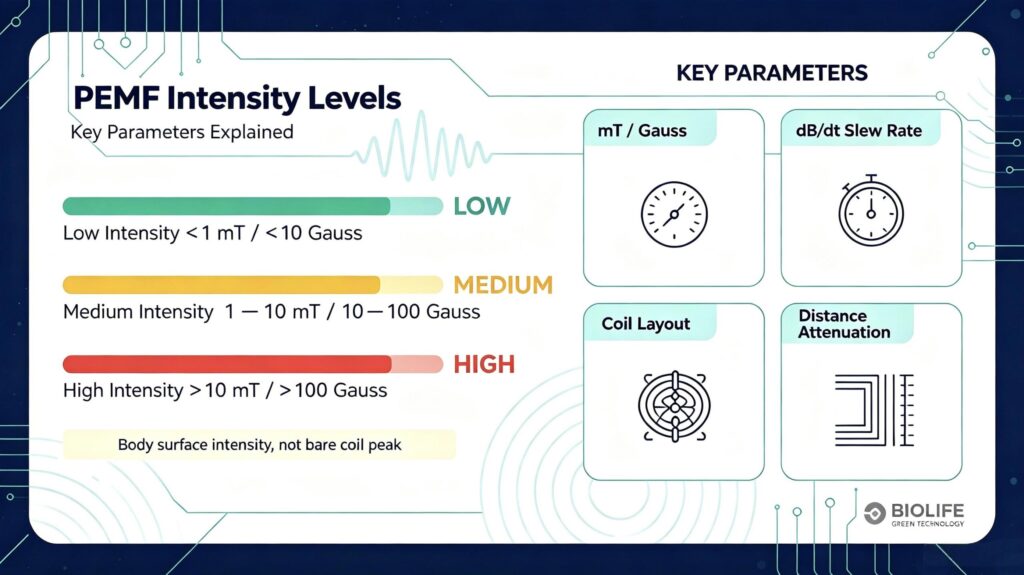
Low intensity: under 1 mT (< 10 G)
| Aspect | Detail |
|---|---|
| Range | 0.1 – 1.0 mT (1 – 10 G) |
| Typical products | Consumer home mats, including systems around 0.15 mT (1.5 G) |
| Engineering profile | Lower drive current; minimal thermal load; extended-session designs feasible; output regulation stability is the critical spec, since ripple that is invisible at 100 G is significant at 2 G |
| Session window | Longer by design convention, subject to device Instructions for Use |
Published research in this band: a rodent gestational exposure study used 5–16 Gauss (0.5–1.6 mT) with induced voltage 1.2–13.5 mV, at 8 h/day or 24 h/day exposure. It found no significant detrimental effects on pregnancy or on prenatal and postnatal development (PMID 3450765). A separate in vitro embryo culture study at 0.6 V/m found embryotoxicity at 20 and 50 Hz and malformation incidence of 22% and 30% at 50 and 70 Hz (PMID 2218943); the same study found no malformations in vivo.
Level 4 evidence — animal and in vitro. It does not establish human safety, and it does not establish human risk. Full treatment in our low-intensity article.
Medium intensity: 1 – 10 mT (10 – 100 G)
| Aspect | Detail |
|---|---|
| Range | 1 – 10 mT (10 – 100 G) |
| Typical products | Professional and semi-professional systems; some higher-output consumer mats |
| Engineering profile | Higher drive current; thermal management becomes a design requirement; coil gauge and cooling path matter |
| Position within band | The upper end (50–100 G / 5–10 mT) is strong for a home wellness product and calls for shorter, controlled sessions per device manual |
This is the band in which most published musculoskeletal research sits — though usually with localised applicators rather than mats.
| Study | Design | Intensity / parameters | Result |
|---|---|---|---|
| Cianni et al. 2024 (J Clin Med 13(7):1959, DOI 10.3390/jcm13071959) | PRISMA systematic review, 17 studies, 1,197 patients | Heterogeneous devices; treatment duration 15 to 90 days | VAS ↓60%, WOMAC 42% improvement. Authors certify no commercial conflicts and flag: “the variability in the treatment duration and device types calls for further investigation” |
| Tong et al. 2022 (PMC9110240) | Meta-analysis, 11 RCTs, 614 patients | Heterogeneous | Pain SMD 0.71 (95% CI 0.08–1.34); stiffness SMD 1.34 (0.45–2.23); function SMD 1.52 (0.49–2.55). Note the pain CI lower bound sits at 0.08 |
| Vavken et al. 2009 (J Rehabil Med) | Meta-analysis restricted to blinded placebo comparisons | Heterogeneous | Refuted effectiveness |
| Ozgüçlü et al. (PMID 20473540) | RCT, n=40, PEMF added to hot pack + ultrasound + isometric exercise | 55 min/session, 5×/week, 2 weeks | Null. WOMAC pain p=0.906, stiffness p=0.855, function p=0.809; acetaminophen p=0.289 |
| Hashemi et al. (PMID 40270637) | Double-blind RCT, n=70 women, PEMF + physical therapy | 30 min/day, 15 sessions over 3 weeks | Positive. VAS p=0.003; function and stiffness at 7 weeks p=0.008 |
| Chinese multicentre OA programme | Multicentre, randomised, single-blind; versus oral celecoxib | 75 Hz at 1.6 mT | Endpoints at 0, 3, 6, 10, 18, 30 weeks |
| Pain Ther 2025 (PMID 39928254, NCT05244187) | Multicentre RCT, n=120 (91 analysed), joint and soft tissue pain | Commercially available FDA-cleared device | Pain change −1.8 (36% reduction) vs −0.46 (10%) for standard of care, p<0.0001; pharmacologic use 40%→18% vs 40%→35% |
| Perumal et al. 2022 (PMID 36242089) | Double-blind RCT, n=118, post-appendicectomy | Active vs inactive device added to standard analgesia | Null. 12-h cumulative pain p=0.6192–0.2985 (rest), p=0.9892–0.7296 (movement); fentanyl use p=0.7344–0.5234 |
The pattern across these eight studies is consistent and worth understanding: where PEMF was compared against a sham device added to comprehensive background therapy, results were null. Where it was compared against standard or lighter care, results were positive. The comparator explains more of the divergence than intensity does.
High intensity: above 10 mT (> 100 G)
| Aspect | Detail |
|---|---|
| Range | > 10 mT (> 100 G) |
| Typical products | Professional localised applicators; orthopaedic bone growth stimulators; some clinical systems |
| Engineering profile | Substantial thermal load; rigorous dB/dt control; shorter conventional exposure windows; more substantive EMC filtering and shielding |
| BioLifeTech | We do not manufacture in this band |
Published research at this level concerns a different product category entirely — prescription orthopaedic devices. PEMF holds an FDA approval dating to November 1979 for ununited fractures, based on documented outcomes in 1,007 ununited fractures and 71 failed arthrodeses (Bassett, PMID 7054564). FDA product code MBQ covers peripheral electromagnetic field devices to aid wound healing.
None of that applies to consumer wellness mats, and we do not cite it as though it did.
Comparative summary
| Low (< 1 mT) | Medium (1–10 mT) | High (> 10 mT) | |
|---|---|---|---|
| Peak flux density | 0.1–1.0 mT | 1–10 mT | > 10 mT |
| Thermal load | Minimal | Moderate — cooling is a design requirement | Substantial |
| Output regulation difficulty | Highest relative (ripple proportionally larger) | Moderate | Moderate |
| Conventional session window | Longest | Moderate | Shortest |
| Typical product form | Whole-body consumer mats | Professional mats, semi-professional systems | Localised applicators, clinical systems |
| Published research volume | Low; mostly animal safety data | Highest — musculoskeletal trials and meta-analyses | High — but in orthopaedic device category |
| BioLifeTech products | Yes | Yes | No |
What intensity does not determine
Four things that intensity band alone cannot tell you:
1. Whether a device is well built. Output stability, regulation topology and thermal behaviour vary enormously within a band. Two 3 mT devices can differ more from each other than a 3 mT device differs from a 10 mT one.
2. What the exposure actually is. dB/dt, duty cycle, waveform and coil-to-body distance all matter. Peak Gauss describes one dimension of a four-dimensional specification.
3. Whether a cited study applies. Most musculoskeletal research used localised applicators held against a joint. A whole-body mat at the same nominal band is a different exposure. Check what the study used, not what band it falls in.
4. What you may legally claim. Regulatory status attaches to specific devices and specific indications, not to intensity bands. BioLifeTech products are FDA Registered and 510(k) Exempt; that status does not change with output level.
Selecting an intensity band: a B2B framing
For brand owners and distributors, the useful question is not “which intensity works best.” It is:
Which band matches your target market, your claim scope, and your regulatory jurisdiction?
| Consideration | Low band | Medium band |
|---|---|---|
| Target channel | Home wellness, hospitality, spa | Professional wellness centres, fitness recovery, supervised facilities |
| Session design | Extended, passive, overnight-capable | Structured, timed sessions |
| Thermal management | Minimal | Required — cost and reliability factor |
| Claim scope in most jurisdictions | General wellness, relaxation | General wellness, relaxation, temporary muscle comfort — check destination market |
| BOM cost driver | Regulation stability | Coil gauge, drive stage, cooling |
| EMC compliance burden | Lower | Moderate |
A note on claim scope. The claims you may legally carry are set by your destination market’s regulator. In China, the NMPA《磁疗产品注册技术审查指导原则》(2016 revision) prohibits naming magnetic therapy devices by reference to treated diseases or therapeutic efficacy. In the US, attaching a disease claim to a 510(k) Exempt wellness product creates an unapproved therapeutic claim regardless of intensity.
Discuss intended claim scope with your manufacturer before finalising specifications. The claims you can carry determine the product you should build — not the other way around.
Frequently asked questions
What are the PEMF intensity levels?
The commonly used commercial convention is low (under 1 mT / 10 G), medium (1–10 mT / 10–100 G) and high (above 10 mT / 100 G). These are not ratified international standards, and nothing changes in tissue at the boundaries. They are useful for organising product lines.
Is medium intensity better than low intensity?
Not established. Most published musculoskeletal research sits in the 1–10 mT band, but it used localised applicators rather than whole-body mats, and results diverge substantially depending on the comparator used. Cellular response is generally described in terms of biological windows rather than monotonic scaling.
Which intensity band has the most research?
Medium (1–10 mT), for musculoskeletal applications. A 2024 PRISMA systematic review pooled 17 studies and 1,197 patients; a 2022 meta-analysis pooled 11 RCTs and 614 patients. Both found substantial heterogeneity in devices and durations.
Do PEMF intensity study results apply to mats?
Generally not without checking. Most trials used localised applicators over a specific joint or fracture site. Exposure geometry and dose differ substantially from a whole-body mat.
How do I convert Gauss to millitesla?
1 mT = 10 G. Divide Gauss by ten. A “100 Gauss” product and a “10 mT” product have identical output.
Does higher intensity mean a stronger effect?
Not demonstrated. Higher intensity brings greater thermal load, higher dB/dt and shorter conventional exposure windows. No published evidence establishes a monotonic dose-response across these bands.
Related reading
- Low-Intensity PEMF (1–10 Gauss): Specifications, Safety Data and Sourcing Criteria
- What Is PEMF Intensity? Definition, Working Principle & Core Parameters
- PEMF Frequency: Classification, Principles and What the Evidence Supports
- What is the PEMF Mat?
Sources
- Cianni L, et al. Current Evidence Using Pulsed Electromagnetic Fields in Osteoarthritis: A Systematic Review. J Clin Med. 2024;13(7):1959. DOI 10.3390/jcm13071959. PMID 38610722.
- Tong J, et al. The Efficacy of PEMF on Pain, Stiffness, and Physical Function in Osteoarthritis: A Systematic Review and Meta-Analysis. PMC9110240, 2022. DOI 10.1155/2022/9939891.
- Vavken P, et al. Effectiveness of PEMF in the management of osteoarthritis of the knee: a meta-analysis of randomized controlled trials. J Rehabil Med. 2009.
- Ozgüçlü E, et al. Additional effect of PEMF therapy on knee osteoarthritis treatment: a randomized, placebo-controlled study. PMID 20473540.
- Hashemi SE, et al. Efficacy of PEMF therapy in the treatment of knee osteoarthritis: a double-blind RCT. PMID 40270637.
- Evaluating Noninvasive PEMF Therapy for Joint and Soft Tissue Pain Management: A Prospective, Multi-center, Randomized Clinical Trial. Pain Ther. 2025. PMID 39928254. NCT05244187.
- Perumal M, et al. Pulsed electromagnetic fields for post-appendicectomy pain management: a randomized, placebo-controlled trial. 2022. PMID 36242089.
- Biological effects of pulsing electromagnetic fields (PEMFs) on ICR mice — 5–16 Gauss, induced voltage 1.2–13.5 mV. PMID 3450765.
- Effects of pulsing electromagnetic fields on the prenatal and postnatal development in mice and rats: in vivo and in vitro studies — 0.6 V/m at 1–100 Hz. PMID 2218943.
- Bassett CA. Pulsing electromagnetic field treatment in ununited fractures and failed arthrodeses. PMID 7054564.
- FDA Product Classification Database — Product Code MBQ.
- Therapeutic effects of whole-body devices applying PEMF: a systematic literature review. Bioelectromagnetics. 2011;33(2). DOI 10.1002/bem.20703.
- 国家药品监督管理局《磁疗产品注册技术审查指导原则》(2016 修订版).
Disclaimer: BioLifeTech PEMF and infrared therapy products are FDA Registered and classified as 510(k) Exempt medical devices (Class I / Class II as regulated). This registration does not imply that the FDA has approved, endorsed or evaluated these products to diagnose, treat, cure or prevent any disease. Content on this page is for educational and technical information purposes only and is not medical advice. Consult a qualified healthcare professional before use, particularly if you are pregnant or nursing, have an implanted electronic device, or have a pre-existing medical condition.
Last reviewed: [2026.10.12] · Next scheduled review: [2026.10.12 + 12 MONTHS]