NEWS DETAIL
PEMF vs Static Magnets: Why the Evidence Diverges So Hard
Technically reviewed by [Frank Zhao], [R&D Engineering], BioLifeTech — [Manufacturer & R&D Supplier]. Last reviewed: [2026.10.15]
This page has not been reviewed by a licensed clinician. It summarises published research for technical and educational purposes and does not contain medical advice. Clinical decisions should be made with a qualified healthcare professional.
Conflict of interest disclosure. BioLifeTech manufactures PEMF and infrared therapy equipment. This page compares PEMF against static magnet products — a category we do not sell. Where the evidence for PEMF is weak or contradictory, that is stated in the same terms as where it is strong.
Scope note. Neither static magnets nor the orthopaedic PEMF devices discussed in the research literature are the same product category as full-body wellness mats. Conclusions from one do not transfer to the other.
This page is part of our evidence-based content library. Read our Medical Disclaimer.
Magnetic wristbands. Copper bracelets with insets. Magnetic insoles. Magnetic mattress pads.
Then, separately: PEMF devices used in orthopaedic clinics for fracture nonunion, with an FDA approval dating to 1979.
Consumers group these together constantly, because the word “magnet” appears in both. Regulators, insurers and the research literature do not group them together at all — and the gap between the two evidence bases is unusually wide.
Understanding why is useful whether you are a patient deciding what to buy, a clinician fielding questions, or a distributor evaluating this product category.
The physics difference is the whole story
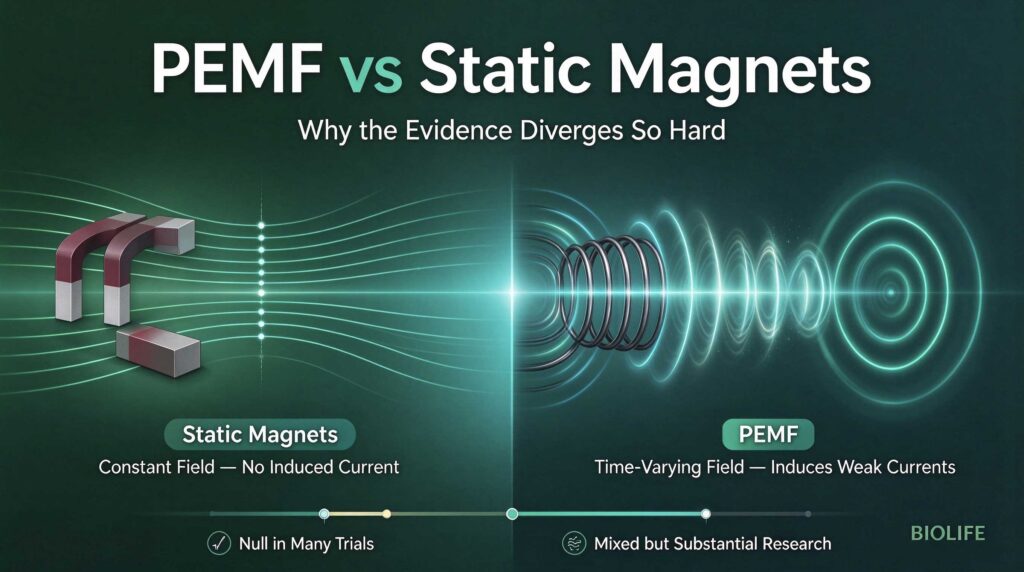
A static magnet produces a constant field. Field strength does not change over time.
A PEMF device drives current through a coil to produce a time-varying field — pulsed at a defined frequency, with a defined waveform, intensity and duty cycle.
That is not a cosmetic distinction. By Faraday’s law of induction, a changing magnetic field induces electric currents in conductive tissue. A constant field does not induce anything.
Bassett’s description of the original bone-healing application is explicit about the mechanism: “PEMFs induce weak electric currents in bone by external coils on casts or skin.” (PMID 7054564)
Every biological mechanism proposed for PEMF sits downstream of that induced current — calcium signalling, calmodulin-dependent nitric oxide release, cGMP synthesis, protein kinase G activation, FGF-2 and VEGF expression. A static magnet has no route into any of those pathways, because it has no time-varying component to induce a current in the first place.
| Terms | Static magnet | PEMF |
|---|---|---|
| Field over time | Constant | Pulsed, time-varying |
| Induced current in tissue | None | Yes — this is the operative mechanism |
| Specifiable parameters | Field strength only | Frequency (Hz), intensity (Gauss or mT), waveform, duty cycle, session duration |
| Dose reproducibility | Low | Defined by device settings |
What the evidence says about static magnets
The definitive synthesis is Pittler and colleagues, published in CMAJ in 2007 — a systematic review and meta-analysis of randomised trials of static magnets for pain reduction. It has been cited over 190 times.
Overall conclusion: no significant effects of static magnets for pain relief relative to placebo. Subgroup analysis by peripheral joint sites did not change the finding.
The US National Center for Complementary and Integrative Health reaches a consistent position. In its assessment of electromagnetic therapy used alongside other physical therapies such as hot packs, pain relief was not further increased by adding the electromagnetic component.
China’s regulator has taken a harder line still. The NMPA’s《磁疗产品注册技术审查指导原则》(2016 revision) specifies that magnetic therapy medical devices may not be named by reference to treated diseases or therapeutic efficacy. The state science communication platform 科学辟谣 has published a direct rebuttal of claims that magnetic therapy products treat cervical spondylosis or arthritis, noting there is currently no high-quality evidence for such effects, and attributing perceived benefit to placebo response or to the warmth and mechanical support provided by a knee or neck sleeve — neither of which has anything to do with magnetism.
That last point is worth sitting with. When a magnetic knee sleeve helps someone, the plausible mechanisms are compression, retained heat, and the behavioural effect of having decided to treat the problem. All three would occur with an identical non-magnetic sleeve.
What the evidence says about PEMF
A different picture — with caveats that we cover in dedicated evidence audits elsewhere on this site.
PEMF has:
- An FDA approval dating to November 1979 for ununited fractures, based on documented outcomes in over 1,000 cases
- Additional FDA classification for bone growth stimulation (Class III), including as an adjunct to cervical fusion in high-risk patients
- FDA product code MBQ for peripheral electromagnetic field devices to aid wound healing
- An established literature in postsurgical pain and oedema management
The clinical evidence is not uniformly positive, and we would be doing you a disservice to imply otherwise. Cochrane reviews have found that a beneficial effect size has not been demonstrated for delayed union of long bone fractures. The knee osteoarthritis literature contains both strongly positive trials and flatly negative ones — a 2022 meta-analysis of 11 RCTs found a pain SMD of 0.71, while a 2009 meta-analysis restricted to blinded placebo comparisons concluded the opposite.
But there is a substantial body of randomised and controlled research, and the debate is about effect size and study design, not about whether the modality does anything at all.
That is a categorically different position from static magnets, where the pooled result across trials is null.
Side by side
| Terms | Static magnets | PEMF |
|---|---|---|
| Regulatory status | Consumer product; not a medical device in most jurisdictions | FDA-approved or cleared for specific indications; consumer variants Registered/510(k) Exempt |
| Meta-analysis result for pain | No significant effect vs placebo (Pittler 2007, CMAJ) | Mixed. Positive pooled estimates in some analyses; null when added to comprehensive physical therapy |
| Evidence base size | Small, consistently null | Large, heterogeneous, contested |
| Typical price point | $10–$80 | $500–$5,000+ |
| Named-disease claims permitted | Not in China; unregulated consumer claims elsewhere | Only within the device’s cleared indication |
Why the confusion persists
Three reasons, and none of them are innocent.
Shared vocabulary. “Magnetic therapy” covers both categories. A consumer searching for information gets bracelet marketing pages and orthopaedic literature in the same results set, with no visual way to tell them apart.
Category bleed in both directions. Some PEMF marketing borrows the wellness framing of consumer magnet products — which imports the evidentiary weakness of that category into a field that does not deserve it. The reverse also happens: sceptics dismiss PEMF wholesale as “magnet quackery” without engaging with four decades of orthopaedic literature. Both shortcuts are lazy, and both are common.
Regulatory asymmetry. Static magnet products face almost no claim scrutiny, because in most jurisdictions they are not devices at all. PEMF manufacturers face real scrutiny — and some respond by marketing under general wellness claims to sidestep it, forfeiting the strongest asset they have. This is why a manufacturer that states its regulatory position plainly, including the limits of that position, is generally a better signal than one that says “FDA approved” without a number.
What to check before you buy
Four questions that separate the categories reliably:
1. Does it require power?
If the product works without electricity and produces a constant field, it is a static magnet. The Pittler meta-analysis is the relevant evidence.
2. Is a frequency stated?
A PEMF device specifies Hz, field strength in Gauss or millitesla, and typically a duty cycle. If none of these appear in the specifications, treat it as a static product regardless of the marketing language.
3. Is there a regulatory number?
Ask for the product code, 510(k) number or PMA number, then verify it in the FDA databases yourself. “FDA Registered” is the weakest of the four statuses and is the one most often presented as the strongest.
4. Are disease claims attached?
If a device is cleared for bone nonunion and the site claims benefits for sleep, immunity or neurological conditions, those claims have not been evaluated by any regulator. That is a red flag about the seller, independent of whether the device itself is legitimate.
Frequently asked questions
Do magnetic bracelets work for pain?
The best available evidence says no. A 2007 CMAJ systematic review and meta-analysis of randomised trials found no significant effects of static magnets for pain relief relative to placebo. Perceived benefit is plausibly attributable to placebo response, warmth, and mechanical support.
Is PEMF just a stronger magnet?
No. PEMF produces a time-varying field that induces electrical currents in tissue, which is the proposed mechanism of action. Static magnets produce a constant field and induce no current. Strength is not the distinguishing variable; time-variance is.
Are PEMF devices regulated?
Specific PEMF devices are FDA-approved or cleared for defined indications including bone nonunion, cervical fusion adjunct use, and wound healing. PEMF as a general modality is not “FDA approved.” Most consumer wellness devices are FDA Registered and 510(k) Exempt, which involves no efficacy review.
Can I use a static magnet instead of PEMF?
They are not interchangeable. The evidence bases are not comparable, and static magnets hold no regulatory clearance for any medical indication in the United States.
Why do some people report that magnetic bracelets help them?
Placebo response is real and measurable, and it is not the same as “imagined.” Compression and retained warmth from a sleeve also produce genuine symptomatic benefit. None of these effects require a magnetic field, which is precisely why the randomised trials against sham devices come back null.
Sources
- Pittler MH, et al. Static magnets for reducing pain: systematic review and meta-analysis of randomized trials. CMAJ. 2007;177(7):736. Cited 190+.
- NCCIH. Magnets for Pain: What You Need To Know. nccih.nih.gov
- Bassett CA. Pulsing electromagnetic field treatment in ununited fractures and failed arthrodeses. PMID 7054564.
- Electromagnetic field stimulation for treating delayed union or non-union of long bone fractures in adults. Cochrane Database Syst Rev. PMC12754039.
- Tong J, et al. The Efficacy of PEMF on Pain, Stiffness, and Physical Function in Osteoarthritis: A Systematic Review and Meta-Analysis. PMC9110240, 2022.
- Vavken P, et al. Effectiveness of PEMF in the management of osteoarthritis of the knee: a meta-analysis of randomized controlled trials. J Rehabil Med. 2009.
- FDA Product Classification Database — Product Code MBQ.
- 国家药品监督管理局《磁疗产品注册技术审查指导原则》(2016 修订版).
- 科学辟谣平台(科普中国):磁疗产品能治疗颈椎病、关节炎?没有依据.
Medical disclaimer
This page summarises published research and regulatory records. It is not medical advice, and it does not establish that any product is appropriate for any individual. BioLifeTech products are FDA Registered and 510(k) Exempt; they are intended for general wellness, relaxation, temporary pain relief and educational purposes, and are not intended to diagnose, treat, cure or prevent any disease. Consult a qualified healthcare professional before use, particularly if you are pregnant or nursing, have an implanted electronic device, or have a pre-existing medical condition.
Last reviewed: [2026.10.15] · Next scheduled review: [2026.10.15 + 6 MONTHS]