
NEWS DETAIL
CE vs FDA vs FCC: Which Certifications Do PEMF Mats Need?
Technical Reviewer: [Frank Zhao], [Professional Credentials], [Specialization in PEMF R&D Development]
Quick Answer: Do PEMF Mats Need CE, FDA, and FCC Certifications?
PEMF mats may require different regulatory approvals, conformity assessments, registrations, and testing procedures depending on their intended use, technical design, and target market.
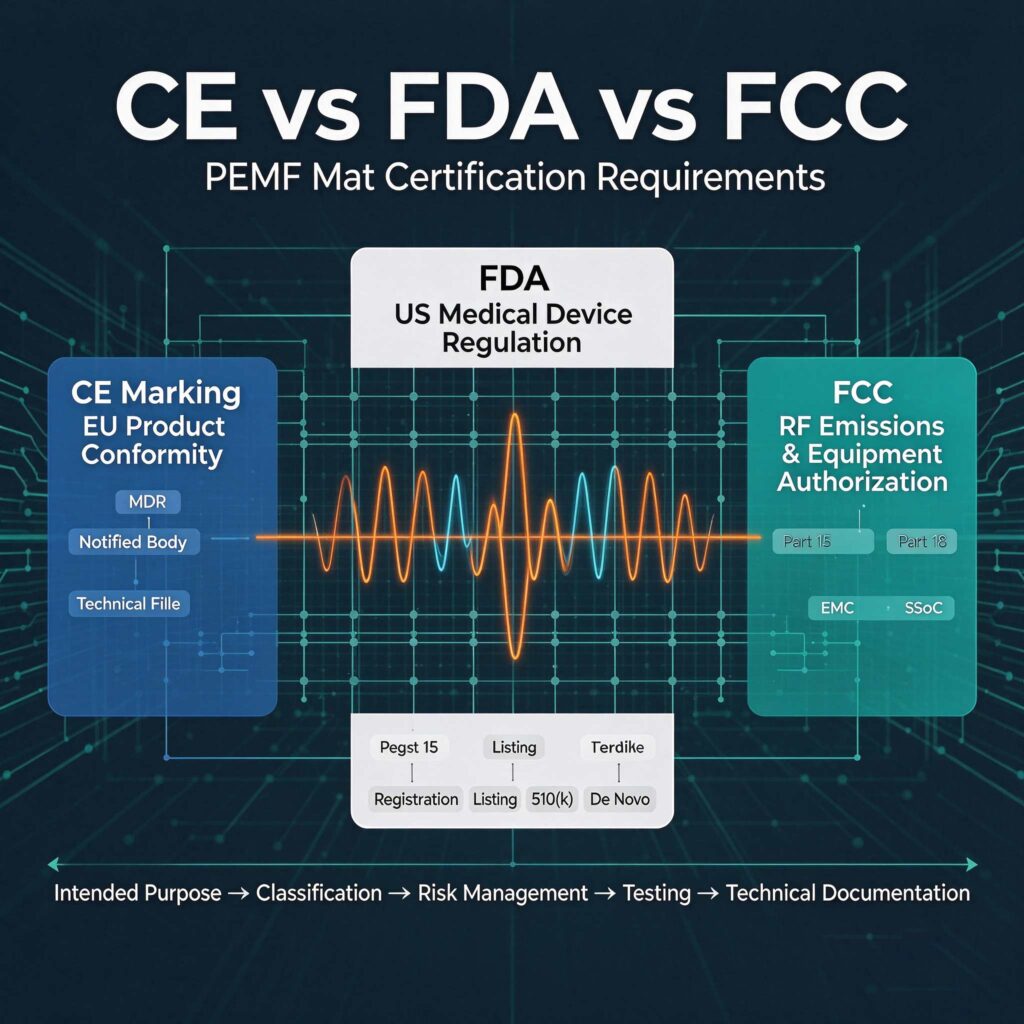
CE, FDA, and FCC serve different regulatory purposes:
- CE Marking: Demonstrates that a product meets the applicable European Union requirements before the manufacturer places it on the European Economic Area (EEA) market.
- FDA Regulation: Determines whether a PEMF product falls under US medical device regulations and, if so, which registration, listing, classification, and premarket requirements apply.
- FCC Compliance: Addresses radiofrequency emissions and electromagnetic interference from electronic equipment marketed in the United States.
A PEMF mat marketed as a medical device may require a medical device conformity assessment in Europe and an applicable FDA regulatory pathway in the United States. Meanwhile, its electronic controller may also need to satisfy FCC equipment authorization requirements.
However, these requirements do not automatically apply in the same way to every PEMF product.
The manufacturer must first establish the product’s intended purpose, technical characteristics, and regulatory classification. Only then can it determine which approvals and tests it needs.
1. Why Do PEMF Mat Manufacturers Need to Understand CE, FDA, and FCC?
The global PEMF market includes traditional electromagnetic mats, heated PEMF mats, red-light combination mats, and products containing natural crystals or mineral heating elements.
Although these products may look similar, their internal structures can differ considerably.
A typical PEMF mat may contain:
- An electronic power supply.
- A control circuit that generates pulsed electrical current.
- Electromagnetic coils.
- Electrical wiring and connectors.
- Temperature control and heating components, where applicable.
- Red or near-infrared LED arrays, where applicable.
- Digital displays, wireless controllers, or Bluetooth modules.
Each component can introduce additional technical and regulatory considerations.
For example, the electromagnetic coil system generates pulsed magnetic fields, while the controller may produce unwanted electromagnetic emissions. A heating system introduces additional electrical and thermal safety requirements. Bluetooth connectivity may also bring wireless equipment requirements into the regulatory assessment.
Therefore, manufacturers should not assume that one certificate covers every function of a multi-technology PEMF mat.
1.1 Three Regulatory Systems, Three Different Purposes
The most important distinction is that CE, FDA, and FCC do not regulate the same aspects of a product.
| Regulatory System | Market | Main Responsibility | Main Question |
|---|---|---|---|
| CE Marking | European Economic Area | Product conformity with applicable EU legislation | Does the product meet the applicable European requirements? |
| FDA | United States | Medical device and certain other product regulation | Can the product legally be marketed for its intended medical purpose? |
| FCC | United States | Radiofrequency emissions and equipment authorization | Does the electronic equipment comply with applicable FCC requirements? |
A manufacturer may need to address more than one regulatory system when selling the same PEMF mat internationally.
For example, a product intended for therapeutic use in the United States may need an applicable FDA pathway. Its electronic controller may also require FCC authorization. When the manufacturer sells the same product in Europe, it must evaluate the relevant CE conformity requirements.
These processes are related to different aspects of product compliance, so manufacturers should treat them separately.
2. CE Marking for PEMF Mats: European Market Requirements
2.1 What Does CE Marking Mean?
CE stands for Conformité Européenne.
The CE marking indicates that the manufacturer declares the product conforms to the applicable EU harmonisation legislation.
For products placed on the European Economic Area market, manufacturers must identify the relevant legislation, complete the required conformity assessment, prepare technical documentation, and issue an EU Declaration of Conformity where applicable.
Importantly, CE marking is not a universal product certification issued by the European Commission.
Manufacturers remain responsible for demonstrating compliance. Depending on the product category and risk classification, they may also need a third-party conformity assessment from a Notified Body.
The European Commission explains these responsibilities in its official guidance:
https://single-market-economy.ec.europa.eu/single-market/goods/ce-marking_en
2.2 Is a PEMF Mat a Medical Device Under EU MDR?
The answer depends primarily on the manufacturer’s intended purpose.
Under Regulation (EU) 2017/745, commonly called the Medical Device Regulation (MDR), a product may qualify as a medical device when its manufacturer intends it for medical purposes such as:
- Diagnosis of disease
- Prevention of disease
- Monitoring of disease
- Treatment or alleviation of disease
- Investigation or modification of physiological or pathological processes
Therefore, a PEMF mat marketed with claims to treat, relieve, or manage specific medical conditions may fall within the MDR definition of a medical device.
By contrast, a product marketed exclusively for general comfort or non-medical wellness purposes may require a different regulatory assessment.
However, manufacturers cannot determine regulatory status simply by changing the product description. Authorities may consider the complete intended purpose, advertising, instructions, technical characteristics, and other product information.
For this reason, manufacturers should establish their intended purpose before selecting a compliance pathway.
Official regulation:
https://eur-lex.europa.eu/legal-content/EN/TXT/?uri=celex%3A32017R0745
2.3 What Is the Likely MDR Classification of a PEMF Mat?
A powered PEMF mat intended for therapeutic use may fall under the active therapeutic device provisions of MDR Annex VIII, Rule 9.
Rule 9 generally classifies active therapeutic devices intended to administer or exchange energy as Class IIa.
However, the rule classifies such devices as Class IIb when their characteristics may allow them to administer or exchange energy with the human body in a potentially hazardous way, considering the nature, density, and application site of that energy.
This means that manufacturers should not automatically classify every PEMF mat as Class IIa.
The final classification depends on the product’s intended purpose, energy characteristics, risk profile, and the applicable MDR classification rules.
Class IIa is a possible starting point for classification analysis, not a universal classification for all PEMF mats.
A qualified regulatory specialist should review the specific product before the manufacturer determines its MDR classification.
2.4 Does a PEMF Mat Need a Notified Body for CE Marking?
The answer depends on the applicable conformity assessment route.
Under the MDR:
- Class I medical devices generally allow manufacturers to self-declare conformity, provided the device does not fall into a category requiring Notified Body involvement, such as sterile, measuring, or reusable surgical instruments.
- Class IIa devices require Notified Body involvement.
- Class IIb devices also require Notified Body involvement.
- Class III devices require the applicable high-risk conformity assessment procedure.
Consequently, a PEMF mat classified as Class IIa or Class IIb generally requires an appropriate Notified Body assessment before the manufacturer can affix the CE marking under the MDR.
The Notified Body evaluates the device within its designated scope and the applicable conformity assessment procedure.
Manufacturers should verify that the selected Notified Body has the appropriate designation for the relevant medical device category.
2.5 What Documents May a Medical PEMF Mat Need for CE Compliance?
A manufacturer preparing a PEMF mat for the European market should generally establish a regulatory documentation package.
The exact contents depend on the device classification and applicable legislation, but may include:
| Document | Purpose |
|---|---|
| Intended Purpose Statement | Defines the medical purpose and intended users |
| Device Description | Explains product construction, operating principles, and configurations |
| Risk Management File | Identifies hazards and evaluates risk controls |
| Technical Documentation | Demonstrates conformity with applicable MDR requirements |
| Clinical Evaluation | Evaluates clinical evidence supporting safety and performance |
| Electrical Safety Test Reports | Demonstrates relevant electrical safety performance |
| EMC Test Reports | Evaluates electromagnetic compatibility |
| Software Documentation | Supports applicable software-related requirements |
| Usability Engineering Documentation | Evaluates user interaction and foreseeable use errors |
| EU Declaration of Conformity | Records the manufacturer’s declaration of conformity |
| Notified Body Certificate | Provides third-party conformity assessment evidence when required |
The manufacturer must also address relevant obligations involving labelling, traceability, post-market surveillance, vigilance, and registration.
2.6 Which Technical Standards Are Relevant to PEMF Mats?
The applicable standards depend on the product’s regulatory status, design, and intended purpose.
For a medical electrical PEMF mat, manufacturers may need to assess standards such as:
| Standard | General Scope | Potential Relevance |
|---|---|---|
| EN IEC 60601-1 | Basic safety and essential performance of medical electrical equipment | Electrical and mechanical safety |
| EN IEC 60601-1-2 | Electromagnetic disturbances | EMC emissions and immunity |
| EN ISO 14971 | Risk management for medical devices | Product risk analysis and control |
| EN IEC 62366-1 | Usability engineering | User interface and foreseeable use errors |
| EN IEC 62304 | Medical device software lifecycle processes | Applicable software components |
These standards do not automatically apply to every PEMF mat. The manufacturer must identify the relevant harmonised or otherwise applicable standards for the specific product and regulatory route.
For example, a PEMF mat with programmable treatment parameters may require additional software-related assessment. A model with integrated heating may also need to address thermal hazards and temperature control.
Furthermore, manufacturers should check the current European harmonised standards list rather than relying on an old test report or a supplier’s generic certificate.
Official EU medical device standards information:
3. FDA Requirements for PEMF Mats: Entering the US Market
3.1 What Does FDA Regulate?
The US Food and Drug Administration (FDA) regulates medical devices under the Federal Food, Drug, and Cosmetic Act.
A product may fall under FDA medical device regulations when its manufacturer intends it for diagnosing, curing, mitigating, treating, or preventing disease, or for affecting the structure or function of the human body as described in the statutory definition.
Therefore, a PEMF mat marketed for specific medical purposes may qualify as a medical device.
For example, claims that a product treats a diagnosed condition can trigger a different regulatory analysis from claims that it provides general comfort.
The FDA’s official guidance explains how to determine whether a product is a medical device:
3.2 Is FDA Registration the Same as FDA Approval?
No. This is one of the most important distinctions for PEMF manufacturers.
The FDA does not issue a general “FDA Certificate” that proves a medical device has been approved.
Several different regulatory terms appear in the US medical device market:
FDA Establishment Registration
A manufacturer or other regulated establishment may need to register its facility with the FDA.
FDA Device Listing
A manufacturer may also need to list the medical devices it markets.
FDA 510(k) Clearance
Certain medical devices require a premarket notification demonstrating substantial equivalence to an appropriate legally marketed predicate device.
FDA De Novo Authorization
Some novel, low-to-moderate-risk devices may use the De Novo classification pathway when they meet the applicable requirements.
PMA Approval
Certain high-risk medical devices require Premarket Approval (PMA).
These terms describe different regulatory processes.
The FDA specifically warns that establishment registration and device listing do not constitute approval, clearance, or authorization of a medical device.
It also does not issue FDA registration certificates for medical device establishments.
Official FDA guidance:
3.3 Does Every PEMF Mat Need FDA 510(k) Clearance?
No. A 510(k) submission is not automatically required for every PEMF product.
The applicable FDA pathway depends on the device’s classification, intended use, technological characteristics, and any applicable exemptions.
Manufacturers should investigate:
- Whether the product meets the FDA definition of a medical device.
- Which FDA classification and product code apply.
- Whether the device is exempt from premarket notification.
- Whether a 510(k), De Novo, or PMA pathway applies.
- Which establishment registration and device listing obligations apply.
Importantly, manufacturers should not assume that another PEMF mat’s FDA clearance automatically covers their own product.
A predicate device must be appropriate, and the manufacturer must establish substantial equivalence where the 510(k) pathway applies.
3.4 How Should a PEMF Manufacturer Determine Its FDA Classification?
The manufacturer should start with the FDA’s device classification database and relevant regulations.
The search should consider:
- Intended medical indication
- Device operating principle
- Type of energy delivered
- Application method
- Patient-contact characteristics
- Technological differences from legally marketed devices
- Existing FDA product codes
A PEMF mat should not be assigned a classification solely because another manufacturer describes a similar product as Class II.
The FDA classification process requires a product-specific assessment.
The FDA’s device advice resource provides information about the steps involved in studying and marketing medical devices:
3.5 FDA Quality System and Manufacturing Requirements
Medical device manufacturers must also consider the FDA’s applicable quality system requirements.
The FDA Quality Management System Regulation (QMSR), effective February 2, 2026, incorporates ISO 13485:2016 by reference, with additional FDA-specific requirements.
For PEMF manufacturers, an effective quality management system should address:
- Design and development controls
- Supplier qualification
- Component traceability
- Production process controls
- Inspection and testing
- Nonconforming product management
- Corrective and preventive action processes
- Complaint handling
- Post-market obligations
These controls are particularly important for PEMF mats because manufacturers may use different coil suppliers, electronic components, power adapters, heating elements, and controller configurations.
A change to one of these components may affect the device’s electromagnetic output, electrical safety, or regulatory documentation.
Manufacturers should therefore maintain appropriate design and production records for each product configuration.
4. FCC Requirements for PEMF Mats: Electromagnetic Emissions and Compliance
4.1 What Does FCC Regulate?
The Federal Communications Commission (FCC) regulates communications and radiofrequency equipment in the United States.
For PEMF manufacturers, the most relevant considerations generally involve electromagnetic emissions and equipment authorization.
Electronic PEMF controllers contain switching circuits, digital electronics, power supplies, and other components that may generate unwanted electromagnetic emissions.
These emissions can interfere with nearby electronic equipment or communication systems if the product does not meet the applicable requirements.
Therefore, a PEMF mat may need FCC compliance assessment even when its primary function is not wireless communication.
4.2 FCC Part 15 vs. Part 18: Which One Applies?
This is a particularly important technical question.
The FCC has different regulatory provisions for different equipment types.
FCC Part 15
Part 15 covers intentional, unintentional, and incidental radiators.
An unintentional radiator is equipment that generates radiofrequency energy during its operation but does not intentionally emit that energy through radiation or induction.
A PEMF controller with digital circuits, switching power electronics, or other electronic components may require evaluation under the applicable Part 15 requirements.
Depending on the equipment category, the manufacturer may use Supplier’s Declaration of Conformity (SDoC) or certification.
FCC Part 18
Part 18 covers industrial, scientific, and medical (ISM) equipment that generates and uses radiofrequency energy locally for industrial, scientific, medical, or other permitted purposes.
Whether a particular PEMF product falls under Part 18 depends on its actual technical characteristics and intended operation.
Manufacturers should not assume that every product containing an electromagnetic coil automatically qualifies as Part 18 ISM equipment.
The relevant classification depends on the applicable FCC definitions and technical rules.
4.3 Does a PEMF Mat Need an FCC ID?
Not necessarily.
An FCC ID is associated with equipment that follows the FCC certification procedure.
Some equipment may instead use Supplier’s Declaration of Conformity when the applicable FCC rules permit that route.
Therefore, manufacturers should not assume that every PEMF mat requires an FCC ID printed on the product.
They should first determine:
- Whether Part 15 or Part 18 applies
- Whether the product requires certification or SDoC
- Whether any exemptions apply
- Which emissions limits and test methods are relevant
- Whether the equipment contains a separately authorized wireless module
A laboratory experienced in FCC equipment authorization can help determine the correct testing and authorization route.
Relevant FCC rules include:
- 47 CFR Part 15: https://www.ecfr.gov/current/title-47/chapter-I/subchapter-A/part-15
- 47 CFR Part 18: https://www.ecfr.gov/current/title-47/chapter-I/subchapter-A/part-18
4.4 What Should Manufacturers Test?
The exact testing requirements depend on the FCC classification and product configuration.
Typical evaluation areas may include:
- Conducted emissions
- Radiated emissions
- Applicable frequency ranges
- Operating modes
- Power supply behavior
- Digital controller emissions
- Cable and wiring effects
- Worst-case operating conditions
For a PEMF mat, the testing laboratory should evaluate representative operating modes, including the configurations that may produce the highest emissions.
For example, a controller may produce different emission characteristics at different pulse frequencies, output settings, or switching conditions.
If the mat includes a wireless controller, the manufacturer must also assess the applicable wireless equipment requirements.
5. Do Heated, Red Light, and Crystal-Filled PEMF Mats Need Additional Compliance Testing?
Modern PEMF mats often combine several technologies.
These additions may not change the fundamental definition of PEMF, but they can introduce new hazards and regulatory considerations.
5.1 Heated PEMF Mats
A heated PEMF mat contains both electromagnetic and thermal systems.
Manufacturers should evaluate:
- Maximum surface temperature
- Temperature uniformity
- Heating-element insulation
- Temperature sensor accuracy
- Over-temperature protection
- Automatic shutoff
- Abnormal operating conditions
- Electrical safety during simultaneous PEMF and heating operation
If the device qualifies as a medical electrical device, the manufacturer should also consider the applicable requirements for medical electrical equipment and its accessories.
A heating subsystem may introduce additional risks even when the PEMF circuit itself performs correctly.
5.2 Red Light PEMF Mats
Red-light PEMF mats combine electromagnetic field generation with optical energy delivery.
The optical subsystem introduces additional technical parameters:
- Wavelength
- Irradiance
- Fluence
- Exposure duration
- Optical uniformity
- Light-source temperature
- Eye safety
If the manufacturer makes medical claims about the red-light function, the product’s intended purpose and regulatory status require additional review.
The manufacturer should also evaluate whether the optical system introduces requirements beyond those applicable to the PEMF subsystem.
5.3 Crystal-Filled PEMF Mats
Crystal-filled PEMF mats may contain amethyst, tourmaline, jade, quartz, or other mineral materials.
These materials do not automatically create a new medical device classification.
However, manufacturers should evaluate their effects on:
- Thermal performance
- Mechanical stability
- Product weight
- Material durability
- Surface temperature
- Potential material contamination
- Electrical insulation, where relevant
If the product uses heated mineral components, thermal safety testing becomes particularly important.
Furthermore, manufacturers should distinguish measurable material properties from unsupported therapeutic claims.
5.4 Wireless Controllers and Bluetooth Connectivity
Some PEMF mats use Bluetooth or other wireless technologies to connect with mobile applications or remote controllers.
This introduces an additional regulatory consideration.
For products sold in the United States, wireless modules may require applicable FCC equipment authorization. The manufacturer’s compliance assessment should also consider the final product configuration and the conditions under which an approved module can be integrated.
In the European Union, radio-enabled equipment may fall under the Radio Equipment Directive (RED), depending on its configuration and intended operation.
Therefore, a product with a wireless controller may require additional assessment beyond the basic requirements for a wired PEMF mat.
6. CE vs FDA vs FCC: A Practical Comparison for PEMF Manufacturers
The following table summarizes the main differences.
| Item | CE Marking | FDA | FCC |
|---|---|---|---|
| Main market | European Economic Area | United States | United States |
| Main purpose | EU product conformity | Medical device and other FDA-regulated product oversight | Radiofrequency equipment authorization |
| Main regulatory basis | Applicable EU legislation | Federal Food, Drug, and Cosmetic Act and related regulations | Communications Act and FCC regulations |
| Medical device relevance | MDR may apply | Medical device regulations may apply | Not a medical device approval system |
| Third-party involvement | Depends on legislation and risk class | Depends on the applicable regulatory pathway | Depends on equipment authorization route |
| Common documentation | Technical file, risk assessment, EU Declaration of Conformity | Registration, listing, premarket submission where applicable, quality records | Test reports, SDoC or certification records |
| Main technical focus | Safety, performance, conformity | Safety, effectiveness, intended use, and regulatory classification | Emissions and applicable equipment authorization requirements |
| Does it prove clinical effectiveness? | Not by itself | Only within the scope of the applicable FDA authorization or clearance | No |
The three systems should not be treated as substitutes for one another.
For example, FCC compliance does not establish that a PEMF mat has FDA clearance. Likewise, FDA registration does not demonstrate CE conformity.
7. A Practical Compliance Roadmap for PEMF Mat Manufacturers
Manufacturers can reduce regulatory uncertainty by following a structured process.
Step 1: Define the Product’s Intended Purpose
Start by deciding whether the product is intended for:
- General wellness
- Relaxation or comfort
- Medical treatment
- A specific clinical application
- Professional or home use
This decision influences the regulatory assessment in both the United States and Europe.
Marketing materials, product labels, instructions, and website claims should communicate a consistent intended purpose.
Step 2: Document the Complete Product Architecture
Prepare a complete technical description of the PEMF mat.
Include:
- Power supply
- Electronic control circuit
- Coil configuration
- Current waveform
- Magnetic field output
- Heating elements
- Red-light modules
- Wireless communication components
- User interface
- Safety protection systems
This information helps regulatory specialists identify the applicable requirements.
Step 3: Perform a Regulatory Classification Assessment
For the European market, assess whether MDR applies and determine the appropriate risk classification.
For the United States, determine whether FDA medical device regulations apply and identify the relevant classification and premarket pathway.
For FCC compliance, determine whether the product falls under Part 15, Part 18, or another applicable provision.
Do not rely solely on a competitor’s certificates or a supplier’s generic compliance statement.
Step 4: Conduct Risk Management
Identify hazards associated with each subsystem.
| Subsystem | Potential Hazard | Example Risk Control |
|---|---|---|
| PEMF coils | Unexpected output or electrical fault | Current monitoring and output protection |
| Electronic controller | Component failure or abnormal operation | Circuit protection and design verification |
| Heating system | Excessive temperature | Independent temperature sensor and automatic shutoff |
| Red-light system | Excessive optical exposure | Optical output control and appropriate safety assessment |
| Wireless system | Unauthorized or unreliable communication | Wireless security and applicable radio compliance |
| Power supply | Electrical shock or overheating | Appropriate insulation and protective design |
A structured risk management process helps manufacturers identify foreseeable hazards before production.
Step 5: Prepare the Test Plan
A suitable test plan may include:
- Electrical safety
- Electromagnetic compatibility
- FCC emissions testing
- Magnetic field output verification
- Heating performance
- Optical performance
- Mechanical durability
- Software verification, where applicable
- Environmental and abnormal-operation testing
The test plan should reflect the final product configuration rather than relying only on component-level reports.
Step 6: Complete the Applicable Regulatory Procedures
After testing, the manufacturer should complete the required documentation and regulatory procedures.
Depending on the market and device classification, this may include:
- EU technical documentation
- EU Declaration of Conformity
- Notified Body assessment
- FDA establishment registration
- FDA device listing
- 510(k), De Novo, or PMA, where applicable
- FCC SDoC or certification
- Applicable wireless equipment authorization
Step 7: Maintain Compliance After Market Launch
Compliance does not end when the manufacturer ships the first product.
Manufacturers should maintain:
- Production quality control
- Supplier monitoring
- Product change control
- Complaint management
- Corrective action procedures
- Regulatory documentation
- Post-market surveillance, where applicable
A change in coil design, power supply, heating element, controller, or wireless module may affect the original compliance assessment.
Therefore, manufacturers should evaluate significant design changes before introducing them into production.
8. Common Certification Mistakes Made by PEMF Mat Suppliers
Several recurring mistakes can create regulatory and commercial risks.
Mistake 1: Claiming That FDA Registration Means FDA Approval
FDA establishment registration and device listing do not establish FDA clearance or approval.
Manufacturers should use accurate language when describing their regulatory status.
Mistake 2: Treating CE as a Single Universal Certificate
CE marking depends on the applicable EU legislation.
A product may need to satisfy several requirements, and some medical devices require Notified Body involvement.
A generic CE certificate from an unrelated testing organization does not automatically establish compliance.
Mistake 3: Assuming Every PEMF Mat Requires an FCC ID
Some equipment may follow SDoC rather than certification.
The correct procedure depends on the applicable FCC rules and equipment classification.
Mistake 4: Using a Component Test Report as Proof of Complete Product Compliance
A power supply may have its own compliance documentation. However, that does not automatically demonstrate that the complete PEMF mat complies with all applicable requirements.
The final product may have different electromagnetic emissions, thermal characteristics, and electrical risks.
Mistake 5: Ignoring Additional Functions
Heating, red-light LEDs, wireless controllers, and digital displays can introduce additional compliance requirements.
Manufacturers should assess the complete product rather than evaluating only the PEMF coil assembly.
Mistake 6: Making Medical Claims Without Reviewing Regulatory Consequences
Claims such as “treats arthritis,” “relieves neuropathy,” or “accelerates tissue healing” may influence the regulatory status of a product.
Manufacturers should ensure that their intended purpose, technical documentation, clinical evidence, and marketing claims remain consistent.
9. Frequently Asked Questions About CE, FDA, and FCC for PEMF Mats
Q1. Does a PEMF mat need CE certification to sell in Europe?
If the product falls under EU legislation that requires CE marking, the manufacturer must complete the applicable conformity assessment and affix the CE mark before placing it on the market.
For a PEMF mat intended for medical purposes, the MDR may apply. The exact classification and conformity assessment route depend on the product.
Q2. Does every PEMF mat need FDA 510(k) clearance?
No. FDA requirements depend on the product’s intended purpose, classification, and applicable exemptions.
Some devices require 510(k) clearance, while others may follow a different regulatory pathway or qualify for an applicable exemption.
Q3. Is FDA registration enough to sell a medical PEMF mat in the United States?
Not necessarily.
Establishment registration and device listing are separate from premarket authorization. If the device requires FDA clearance or approval, the manufacturer must complete that process before marketing it.
Q4. Does a PEMF mat need FCC certification?
Some PEMF mats require FCC equipment authorization, but the applicable route depends on the electronic design and relevant FCC rules.
The manufacturer should determine whether Part 15, Part 18, or another provision applies. An FCC ID is not required for every equipment authorization route.
Q5. Can one CE certificate cover all PEMF mat models?
Not automatically.
Different models may use different coils, controllers, heating elements, power supplies, or wireless modules.
Manufacturers should determine whether the models belong to the same product family and whether the available technical evidence adequately covers each configuration.
Q6. If the PEMF controller has FCC compliance, does the complete mat also comply?
Not necessarily.
The complete product may produce different electromagnetic emissions because of its wiring, coils, power supply, enclosure, and operating modes.
Manufacturers should confirm that the relevant test evidence covers the final product configuration.
Q7. Do heated PEMF mats require additional testing?
Yes, manufacturers should evaluate the heating subsystem and its interaction with the PEMF electronics.
Relevant tests may include temperature uniformity, over-temperature protection, insulation, and abnormal operating conditions.
Q8. Do red-light PEMF mats need additional compliance assessment?
Yes, the optical subsystem introduces additional considerations, including wavelength, irradiance, exposure control, and optical safety.
The manufacturer should also determine whether its intended medical claims affect the regulatory classification.
Q9. Can a Chinese manufacturer use the same compliance documents for Europe and the United States?
Some technical test reports may support multiple regulatory assessments, but the manufacturer cannot assume that one document satisfies every requirement.
For example, an EMC test report may provide useful evidence, but EU MDR conformity and FDA medical device authorization involve different regulatory procedures.
Q10. Which should manufacturers obtain first: CE, FDA, or FCC?
There is no universal order.
A better approach is to define the intended markets and product claims first. The manufacturer can then prepare a coordinated regulatory plan covering medical device classification, electrical safety, EMC, FCC authorization, and any additional requirements.
This approach can reduce duplicated testing and avoid unnecessary changes during product development.
10. Conclusion: Compliance Starts with Product Classification, Not the Certificate
CE, FDA, and FCC serve different regulatory purposes. Manufacturers should understand these differences before developing or exporting a PEMF mat.
CE marking addresses conformity with applicable European legislation. FDA regulates medical devices and determines the appropriate US market authorization pathway. FCC addresses radiofrequency equipment and electromagnetic emissions.
For traditional PEMF mats, the main technical considerations include coil design, electronic control, electrical safety, and electromagnetic compatibility.
For heated, red-light, and crystal-filled models, manufacturers must also evaluate the additional thermal, optical, and material-related risks.
Ultimately, the most reliable compliance strategy starts with a clear intended purpose, a complete product architecture, and a product-specific regulatory assessment.
Manufacturers should not purchase certificates simply because competitors display them. Instead, they should determine which requirements actually apply, conduct the necessary tests, and maintain accurate technical documentation.
A compliant PEMF mat is not defined by the number of certificates displayed on its packaging. It is defined by whether the complete product meets the applicable regulatory and technical requirements in its target markets.
References and Official Regulatory Resources
European Union
- European Commission. CE Marking.
https://single-market-economy.ec.europa.eu/single-market/goods/ce-marking_en - Regulation (EU) 2017/745 on Medical Devices (MDR).
https://eur-lex.europa.eu/legal-content/EN/TXT/?uri=celex%3A32017R0745 - European Commission. Harmonised Standards for Medical Devices.
https://single-market-economy.ec.europa.eu/single-market/goods/european-standards/harmonised-standards/medical-devices_en - European Commission. Electromagnetic Compatibility Directive.
https://single-market-economy.ec.europa.eu/sectors/electrical-and-electronic-engineering-industries-eei/electromagnetic-compatibility-emc-directive_en - European Commission. Radio Equipment Directive.
https://single-market-economy.ec.europa.eu/single-market/goods/european-standards/harmonised-standards/radio-equipment_en
United States
- US FDA. How to Determine if Your Product is a Medical Device.
https://www.fda.gov/medical-devices/classify-your-medical-device/how-determine-if-your-product-medical-device - US FDA. How to Study and Market Your Device.
https://www.fda.gov/medical-devices/device-advice-comprehensive-regulatory-assistance/how-study-and-market-your-device - US FDA. Are There FDA Registered or FDA Certified Medical Devices?
https://www.fda.gov/medical-devices/consumers-medical-devices/are-there-fda-registered-or-fda-certified-medical-devices-how-do-i-know-what-fda-approved - US FDA. Important Reminders about Registration and Listing.
https://www.fda.gov/medical-devices/device-registration-and-listing/important-reminders-about-registration-and-listing - US FCC. 47 CFR Part 15.
https://www.ecfr.gov/current/title-47/chapter-I/subchapter-A/part-15 - US FCC. 47 CFR Part 18.
https://www.ecfr.gov/current/title-47/chapter-I/subchapter-A/part-18
Related Articles
- PEMF Coils: An Academic Guide to Coil Design, Magnetic Field Parameters, and Testing
- What Is PEMF Intensity?
- PEMF Mat Therapy: Traditional, Heated, Red Light, and Crystal-Filled PEMF Mats
- What Is PEMF?
- PEMF Therapy: Scientific Research, Clinical Evidence, Treatment Parameters, and Testing Methods