NEWS DETAIL
PEMF Frequency Guide: What Each Hz Range Does and What the Research Supports
Technically reviewed by [Frank Zhao], [R&D / Regulatory Affairs], BioLifeTech — [Professional Manufacturer & R&D Team, Since 2017]. Last reviewed: [2026.10.28]
Conflict of interest disclosure. BioLifeTech manufactures PEMF and infrared therapy equipment in the 0.5–100 Hz range. and this page explains the engineering and research reasons behind common frequency choices rather than recommending any frequency for any condition.
Scope note. This page covers engineering specifications and published parameter usage. It makes no claims about health outcomes from any frequency band and does not recommend frequencies for any condition. Session parameters should follow the Instructions for Use supplied with your specific device.
Read our Medical Disclaimer.
PEMF frequency is one of the most searched — and most misunderstood — specifications in electromagnetic field therapy. Users ask “what frequency should I use?” as if a single number could answer a question that depends on the device, the application, and the published evidence.
This guide explains what PEMF frequency actually means, breaks down each frequency range with what the research used, and gives you a practical framework for understanding your device’s settings.
What is PEMF frequency?
PEMF frequency measures how many complete magnetic pulse cycles occur per second, expressed in Hertz (Hz). A device operating at 10 Hz delivers 10 complete pulse cycles every second.
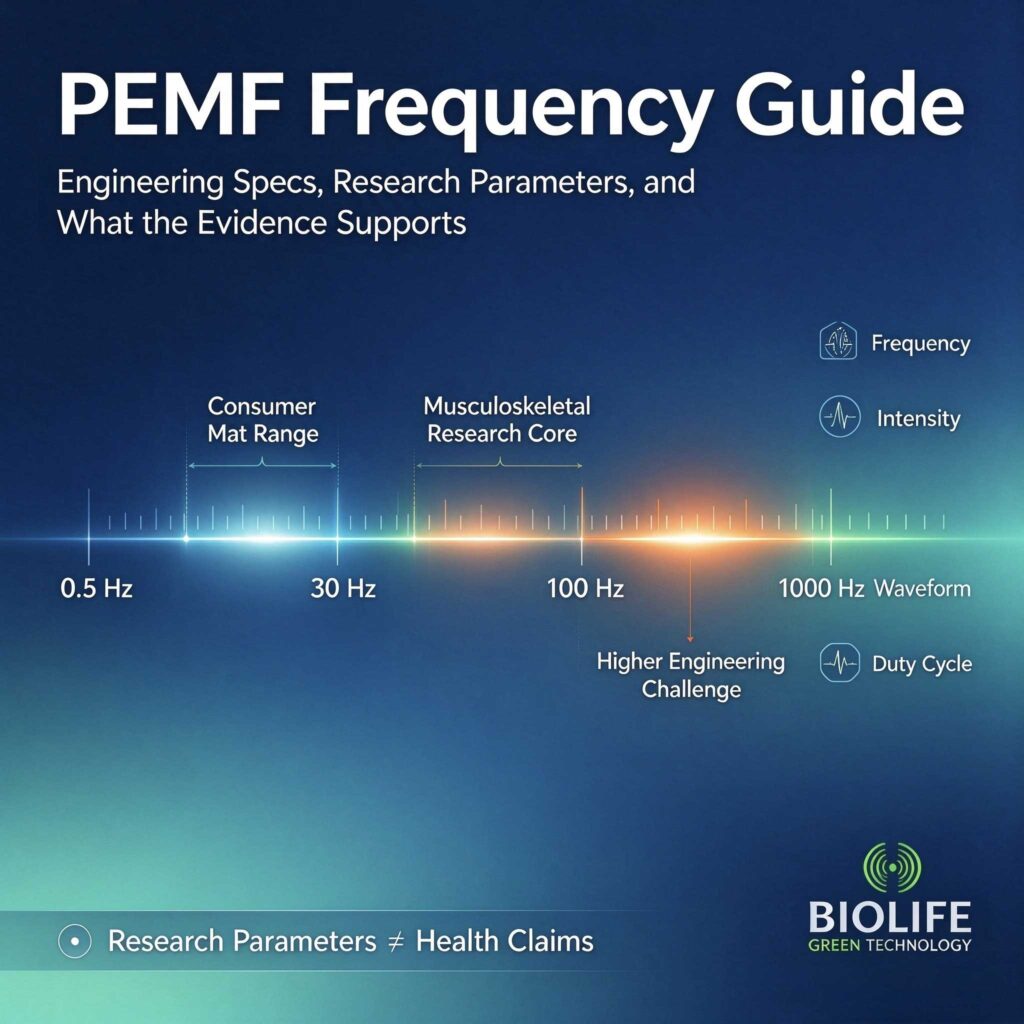
Frequency is one dimension of a multi-parameter specification. Three other parameters are equally important:
| Parameter | What it describes |
|---|---|
| Intensity (Gauss/mT) | How strong the magnetic field is |
| Waveform | The shape of each pulse (square, sinusoidal, sawtooth) |
| Duty cycle | The proportion of time the field is active vs. resting |
A comprehensive PEMF review published in 2023 noted that “most publications for electromagnetic fields are in different frequency regimes” — from the power-net 50–60 Hz region to higher ranges — and that frequency, intensity, and duration all interact to determine biological effect (Flatscher et al., PMC10379303).
A 2024 literature review on pulsed electromagnetic therapy found that specific frequencies serve different purposes: “Frequencies like 2 Hz can improve sleep, 50 Hz can reduce pain and inflammation, and 200–300 Hz can aid in bone growth” (Mayer, PMC11506130).
The three conventional PEMF frequency bands
Low frequency: 0.5–30 Hz
This is the standard preset band for most consumer PEMF mats. It covers the range most commonly associated with relaxation, sleep preparation, and general wellness applications.
Sub-ranges and their common associations:
| Sub-range | Common use | Research basis |
|---|---|---|
| 0.5–4 Hz (delta range) | Sleep preparation, deep relaxation, grounding | Mimics Earth’s natural Schumann resonance (~7.83 Hz fundamental). Low-frequency PEMF at 1–100 Hz has been studied for fibromyalgia (PMID 19826455) |
| 4–10 Hz (theta/alpha range) | Recovery, relaxation, muscle cooldown | Used in several musculoskeletal studies; the 4–12 Hz range showed significant pain reduction in a double-blind OA trial (PMID 26562074) |
| 10–30 Hz | General wellness, circulation support, daytime sessions | Commonly used in consumer PEMF mat presets; 15 Hz has been shown to stimulate osteoblast activity in bone research (Eureka/PatSnap report) |
Engineering characteristics at 0.5–30 Hz:
- Lowest thermal load — enables extended-session designs
- Moderate dB/dt (slew rate) requirements
- Simplest drive electronics
- Lowest EMC compliance burden
- Longest conventional session windows
Medium frequency: 30–100 Hz
This is the band where most published musculoskeletal research sits. It is the therapeutic core of clinical PEMF applications and the most evidence-rich range for pain and recovery.
Key research parameters used in this band:
| Study | Frequency used | Intensity | Duration | Application |
|---|---|---|---|---|
| Thamsborg et al. (PMC5905856) | 50 Hz | Not stated | 2 h/day, 6 weeks | Knee OA |
| Zorzi et al. (PMC5905856) | 75 Hz | 1.5 mT | 6 h/day, 90 days | Knee cartilage repair |
| Gobbi et al. (PMC5905856) | 75 Hz | 1.5 mT | 4 h/day, 45 days | Early knee OA |
| Osti et al. (PMC5905856) | 75 Hz | 1.5 mT | 6 h/day, 60 days | Microfracture for knee OA |
| Bagnato et al. (PMC4795538) | Not stated | Not stated | 12 h/day, 1 month | Knee OA |
| Chinese multicentre OA programme | 75 Hz | 1.6 mT | Per protocol | Knee OA vs oral celecoxib |
| Frontiers in Medicine 2024 (DOI 10.3389/fmed.2024.1435277) | 50 Hz | 1 mT | Per protocol | Knee OA muscle strength |
The 50–75 Hz range is clearly the most-studied frequency band for musculoskeletal applications.
A systematic review of musculoskeletal pain management found that “pulsed magnetic fields at low intensity and frequency (from 1 Hz up to 100 Hz) are commonly used with efficacy in resolving musculoskeletal pain” (DOI 10.2147/JPR.S231778).
Engineering characteristics at 30–100 Hz:
- Moderate thermal load — cooling becomes a design requirement at sustained use
- Moderate dB/dt — slew rate rises progressively toward 100 Hz
- Low-to-moderate drive electronics complexity
- The 50–100 Hz range carries the strongest clinical evidence base for structural tissue repair (PEMF Frequency Guide, juliandouwes.com)
High frequency: 100–1000 Hz
This range is far less common in consumer PEMF devices — not because it is inferior, but because it represents a fundamentally different engineering problem.
Research applications in this band:
| Frequency | Application | Evidence |
|---|---|---|
| 100–300 Hz | Bone growth stimulation | “200–300 Hz can aid in bone growth” (Mayer, PMC11506130) |
| 27 MHz (pulsed) | Persistent neck pain | A double-blind, placebo-controlled study (n=20) found clinical effectiveness for pulsed high-frequency EM therapy (Healio, 1990) |
| 150 Hz | Peripheral nerve regeneration | A study comparing 50 Hz and 150 Hz found that 50 Hz at 1 h/day showed the highest regeneration ability, though both PEMF conditions significantly improved axon counts vs. control (PMID 26010211) |
| Mid-range (100–1000 Hz) | Pain management and tissue repair | “Studies suggest efficacy” but with less clinical evidence than lower frequencies (PatSnap report) |
Engineering challenges at 100–1000 Hz:
- Highest thermal load per unit time
- High dB/dt — must be actively calibrated
- Complex drive electronics requiring specialised components
- Highest EMC compliance burden
- Shortest conventional session windows — not designed for routine full-body use
- Inductive reactance (X_L = 2πfL) rises proportionally with frequency, causing rise-time distortion in the drive waveform unless compensated
Why most consumer mats don’t include this band: the thermal management, EMC filtering, and drive complexity required for safe, stable output at 100–1000 Hz are fundamentally different from the 1–100 Hz design problem. Adding this range to a consumer mat would increase cost substantially while providing no proven benefit for the primary use cases (relaxation, general wellness, daily routine).
PEMF frequency and brainwave entrainment: what the science says
A common marketing claim is that PEMF frequencies can “entrain” brainwaves by matching EEG frequency bands:
| EEG Band | Frequency range | Associated state |
|---|---|---|
| Delta | 0.5–4 Hz | Deep sleep |
| Theta | 4–8 Hz | Relaxation, meditation |
| Alpha | 8–13 Hz | Calm alertness |
| Beta | 13–30 Hz | Active thinking |
| Gamma | 30–100 Hz | High-level processing |
While these frequency ranges overlap with PEMF operating ranges, direct brainwave entrainment via PEMF applied to the body (not the head) is not established in the published literature. The electromagnetic field from a mat primarily interacts with tissues in close proximity to the coils. Claims of “brainwave synchronisation” from a mat placed under the body are not supported by the same evidence as transcranial magnetic stimulation (TMS), which uses entirely different field strengths and coil geometries.
Frequency vs. intensity: which matters more?
This is one of the most important questions in PEMF specification, and the answer is: they interact, and neither alone describes the exposure.
A key concept is dB/dt — the rate of change of magnetic flux density, measured in Tesla per second (T/s). The induced electric field in tissue depends on how rapidly the magnetic field changes, not just how strong it is. Two devices at identical peak Gauss and identical frequency can produce substantially different induced currents depending on waveform shape and rise time.
A 2026 PEMF frequency vs. intensity guide explained: “PEMF frequency describes how often a repeating electromagnetic pattern occurs. PEMF intensity describes the strength of each pulse. Both parameters interact to determine the biological effect” (Holistix International).
The practical implication: a well-designed 50 Hz device with sharp rise times and stable output regulation may deliver a more consistent and effective exposure than a poorly-regulated 100 Hz device with slow rise times and significant waveform distortion.
How to choose a PEMF frequency: a practical framework
| Goal | Frequency range | Rationale |
|---|---|---|
| Sleep / deep relaxation | 1–5 Hz | Mimics delta brainwave range; commonly used for evening and pre-sleep sessions (PEMF.com.au) |
| General recovery / muscle relaxation | 5–15 Hz | Post-exercise cooldown; commonly associated with theta range |
| Daytime wellness / focus | 10–25 Hz | Alpha/beta overlap; “sweet spot” for everyday PEMF use (Holistix) |
| Pain management / musculoskeletal | 50–75 Hz | Most published research sits here; strongest evidence base (PMC5905856) |
| Bone healing | 15–75 Hz | 15 Hz for osteoblast stimulation; 50–75 Hz in most clinical protocols |
| Energy / pre-workout | 20–30 Hz | Associated with enhanced circulation and alertness |
Important caveats:
- These associations are based on common usage patterns and published research parameters, not guaranteed outcomes
- Your device’s Instructions for Use should always take precedence over general frequency guidance
- The frequency that works “best” depends on the full parameter set — intensity, waveform, duty cycle, and session duration all matter
What the research actually used: a frequency summary table
| Frequency | Research application | Evidence level | Source |
|---|---|---|---|
| 2 Hz | Sleep improvement | Preliminary | Mayer, PMC11506130 |
| 4–12 Hz | Knee OA pain reduction | RCT, positive | PMID 26562074 |
| 15 Hz | Osteoblast stimulation | Preclinical | PatSnap |
| 50 Hz | Knee OA, nerve regeneration | Multiple RCTs | PMC5905856; PMID 26010211 |
| 50–75 Hz | Musculoskeletal pain, cartilage repair | Strong (meta-analyses) | PMID 38610722; PMC5905856 |
| 75 Hz | Knee OA (Chinese multicentre) | Multicentre RCT | Chinese multicentre OA programme |
| 150 Hz | Peripheral nerve regeneration | Preclinical | PMID 26010211 |
| 200–300 Hz | Bone growth | Preliminary | Mayer, PMC11506130 |
Frequently asked questions
What is the best PEMF frequency?
There is no single “best” frequency. The optimal frequency depends on the application: 1–5 Hz for sleep and relaxation, 5–15 Hz for general recovery, 50–75 Hz for musculoskeletal pain (the most-studied range). Your device’s Instructions for Use should guide your selection.
What frequency should I use on my PEMF mat?
Most consumer PEMF mats operate in the 1–100 Hz range. For relaxation, lower frequencies (1–10 Hz) are commonly used. For pain and recovery applications, the 30–100 Hz range has the strongest research support. Start with your device’s preset programmes and adjust based on your experience.
Is higher PEMF frequency better?
Not necessarily. Higher frequencies (100–1000 Hz) require more complex drive electronics, produce more heat, and are less common in consumer devices. Most published musculoskeletal research used 50–75 Hz, not the highest available frequencies. Cellular response is described in terms of “biological windows” rather than simple “more is better.”
Can PEMF frequency affect sleep?
Lower frequencies (0.5–4 Hz, the delta brainwave range) are commonly used for sleep preparation on PEMF mats. A 2024 review noted that 2 Hz can improve sleep (Mayer, PMC11506130). However, direct brainwave entrainment from a body-applied PEMF mat is not established in the published literature.
What is the Schumann resonance and does it relate to PEMF?
The Schumann resonance is Earth’s natural electromagnetic frequency, approximately 7.83 Hz. Some PEMF devices include a ~7.8 Hz setting marketed as “Schumann resonance” mode. While this frequency falls within the commonly used relaxation range, the claim that matching Earth’s frequency produces specific biological effects is not established by PEMF-specific clinical research.
Does PEMF frequency matter more than intensity?
Both matter, and they interact. The rate of magnetic field change (dB/dt) — which depends on both frequency and waveform shape — determines the induced electrical current in tissue. A well-regulated 50 Hz device may deliver more consistent exposure than a poorly-regulated 100 Hz device.
Related reading
- PEMF Mat: What It Is, How It Works, and How to Choose
- PEMF Therapy Benefits: What the Evidence Actually Shows
- What Is PEMF Intensity? Definition and Core Parameters
- PEMF Mat Waveform: Square Wave Working Principle
Sources
- Flatscher J, et al. Pulsed Electromagnetic Fields (PEMF). 2023. PMC10379303.
- Mayer Y. Pulsed Electromagnetic Therapy: Literature Review. 2024. PMC11506130.
- PMC5905856 — Clinical Effects of PEMF on Joints (frequency table). Link.
- PMID 26562074 — MAGCELL ARTHRO PEMF study (4–12 Hz). Link.
- PMID 26010211 — PEMF at different frequencies for peripheral nerve regeneration. Link.
- Ghanbari Ghoshchi S, et al. PEMF stimulation as an adjunct to exercise. Front Physiol. 2024. PMC11443222.
- Cianni L, et al. Current Evidence Using PEMF in Osteoarthritis. J Clin Med. 2024;13(7):1959. PMID 38610722. DOI 10.3390/jcm13071959.
- Tong J, et al. PEMF Efficacy in OA: Meta-Analysis. 2022. PMID 35586276. DOI 10.1155/2022/9939891.
- Bagnato GL, et al. PEMF in knee OA: double-blind RCT. Rheumatology. 2016;55(4):755-62. PMC4795538.
- Frontiers in Medicine 2024 — PEMF effects on muscle strength in knee OA. DOI 10.3389/fmed.2024.1435277.
- PMID 19826455 — Low-frequency PEMF in fibromyalgia. Link.
- DOI 10.2147/JPR.S231778 — Electromagnetic field therapy for musculoskeletal pain: systematic review. Link.
- Holistix International — PEMF Frequency Guide. Link.
- Holistix International — PEMF Frequency vs Intensity. Link.
- PEMF.com.au — Best PEMF Frequency for Sleep. Link.
- Julian Douwes — PEMF Frequency Guide. Link.
- PatSnap — Comparing Different Frequency Waves in PEMF Therapy. Link.
- Bassett CA. PEMF treatment in ununited fractures. PMID 7054564.
Disclaimer: BioLifeTech PEMF and infrared therapy products are FDA Registered and classified as 510(k) Exempt medical devices (Class I / Class II as regulated). This registration does not imply that the FDA has approved, endorsed or evaluated these products to diagnose, treat, cure or prevent any disease. Content on this page is for educational and technical information purposes only and is not medical advice. Consult a qualified healthcare professional before use, particularly if you are pregnant or nursing, have an implanted electronic device, or have a pre-existing medical condition.
Last reviewed: [2026.10.28] · Next scheduled review: [2026.10.28 + 12 MONTHS]