NEWS DETAIL
Is PEMF FDA Approved? The Four Regulatory Statuses, Explained
Technically reviewed by [Frank Zhao], [R&D / Regulatory Affairs], BioLifeTech — [Manufacturer & R&D Supplier,Since 2017]. Last reviewed: [2026.10.19]
Conflict of interest disclosure. BioLifeTech manufactures PEMF and infrared therapy equipment. This page describes the regulatory status of PEMF devices generally, including the status of our own products. Where a distinction is unfavourable to us, it is stated anyway. Editorial control over the interpretation of regulatory records rested with [NAME].
Scope note. The FDA approvals and clearances described below apply to specific devices for specific indications. Most of them concern prescription orthopaedic bone growth stimulators and localised applicators — not full-body wellness mats. Regulatory status does not transfer between product categories.
This page is part of our evidence-based content library. Read our Medical Disclaimer.
Search “is PEMF FDA approved” and you will get two kinds of answer. Marketing pages say yes, emphatically, usually without a number. Skeptical pages say no, flatly, usually without a distinction.
Both are wrong, because the question contains a category error.
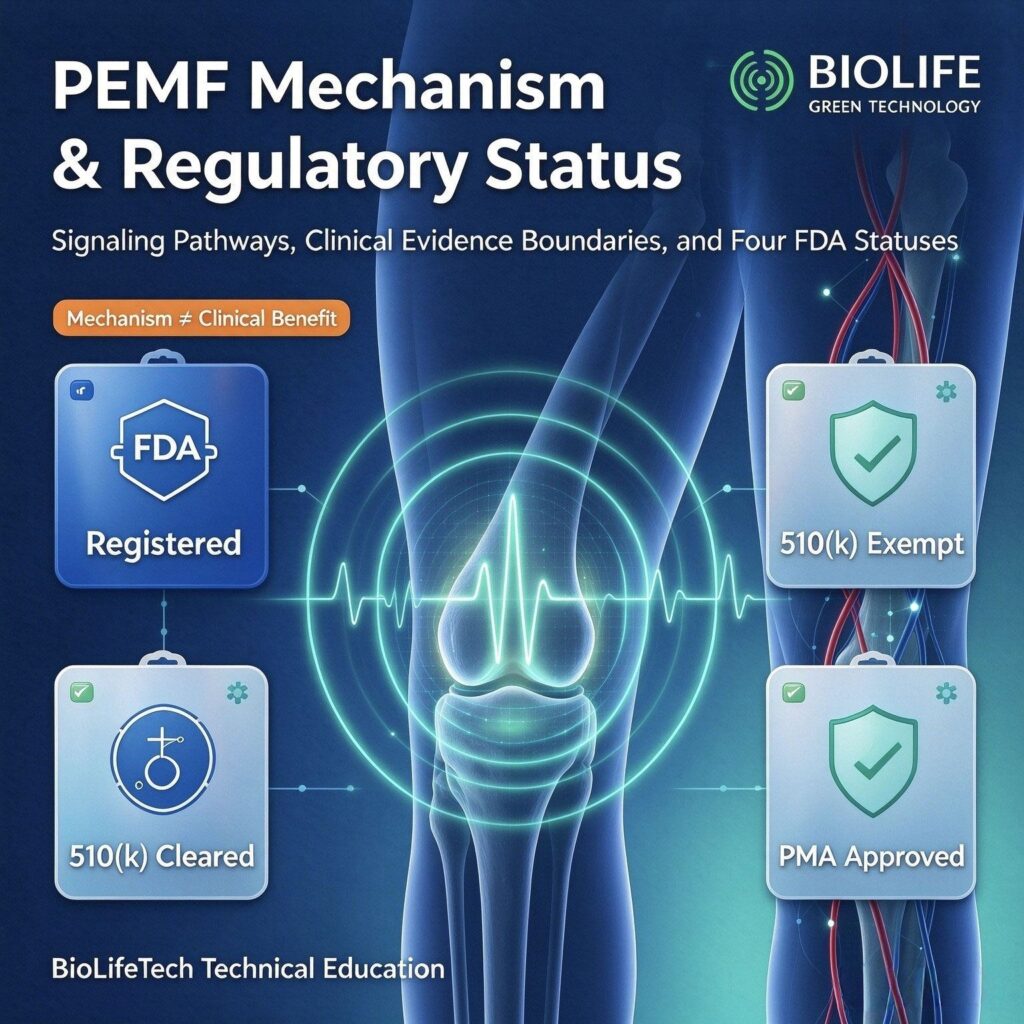
The FDA does not approve therapies. It clears or approves devices, for specific indications, on the basis of specific evidence. And for PEMF products, there are actually four different regulatory statuses a device can hold — three of which are routinely described as “FDA approved” by sellers who should know better.
Here is what each one means, and what the record actually shows.
The four statuses, ranked by what they actually prove
| Status | What it means | What it proves | Common misuse |
|---|---|---|---|
| Establishment Registration + Device Listing (“FDA Registered”) | The manufacturer has told the FDA it exists and makes this device | The FDA knows the company exists. Nothing about safety or efficacy. | Described as “FDA approved” |
| 510(k) Exempt | The device class is exempt from premarket notification | It is low-to-moderate risk by classification. No efficacy review occurred. | Described as “FDA cleared” |
| 510(k) Cleared | FDA found the device substantially equivalent to a legally marketed predicate | Safety and effectiveness for the predicate’s indication | Described as “FDA approved” |
| PMA Approved | FDA found reasonable assurance of safety and effectiveness | Clinical evidence supports the specific indication | Used correctly, rarely |
Most consumer PEMF and infrared wellness products on the market hold the first two statuses. That is a legitimate regulatory position. It is not a clinical endorsement, and describing it as one is the single most common compliance failure in this category.
What BioLifeTech products are — stated plainly
Our infrared therapy mats and wellness devices are FDA Registered and classified as 510(k) Exempt medical devices (Class I / Class II as regulated).
That registration does not mean the FDA has approved, endorsed, or evaluated these products to diagnose, treat, cure, or prevent any specific disease, chronic medical condition, or physical ailment.
We are stating this on a page optimised for the search term “is PEMF FDA approved” because the honest answer is more useful than the profitable one, and because buyers — particularly clinical and distribution partners — need to know exactly what labelling they can and cannot carry in their own markets.
The 1979 decision: where PEMF’s regulatory history actually starts
PEMF does have a genuine regulatory pedigree. It just belongs to a different product category than wellness mats.
In November 1979, the FDA approved pulsed electromagnetic field stimulation for the treatment of ununited fractures — what clinicians call nonunion.
The evidence base was assembled largely by C. Andrew Bassett at Columbia-Presbyterian Medical Center. Reporting confirmed outcomes in 1,007 ununited fractures and 71 failed arthrodeses worldwide, Bassett documented:
| Setting | Reported success rate |
|---|---|
| Columbia-Presbyterian Medical Center | 81% |
| International sites | 79% |
| Other US patients | 76% |
The subgroup data is the more revealing part, because these were not straightforward cases. Among 332 patients with an average disability duration of 4.7 years, an average of 3.4 previous failed operations to achieve union, and a 35% infection rate, PEMF was effective in 75%.
Site-specific results reported in the same work:
| Nonunion site | Union rate |
|---|---|
| Carpal navicular | 84% |
| Femoral neck–trochanteric | 82% |
| Failed arthrodesis after attempted total-knee salvage | 85% |
Bassett also noted that when coils alone were unsuccessful, combining them with surgical repair was effective — the device was positioned from the outset as an adjunct, not a replacement for surgery.
Two honest caveats. These were pooled clinical series, not randomised controlled trials; the 1979 decision predates the modern RCT standard. And the devices involved were external coils applied over a cast or directly over the fracture site — a localised, prescription-use orthopaedic device.
Source: Bassett CA. Pulsing electromagnetic field treatment in ununited fractures and failed arthrodeses. PMID 7054564.
What else is on the books
Beyond the original nonunion indication, several further regulatory facts are verifiable in FDA’s own databases:
Bone growth stimulation (Class III). Specific PEMF devices are approved as non-pharmacological therapies for human bone growth stimulation. A 2020 review states the position directly: “The US FDA has approved pulsed electromagnetic fields (PEMFs) as a safe and effective treatment for nonunions of bone.” (Cadossi et al., PMC7434032)
Cervical fusion adjunct (2004). The FDA approved a PEMF system as an adjunct to cervical fusion surgery in patients at high risk for non-fusion.
Wound healing. FDA’s Product Classification database lists product code MBQ — “Device, peripheral electromagnetic field (pemf) to aid wound healing” — under the Physical Medicine review panel. This is verifiable in the public database, not a manufacturer claim.
Post-operative pain and edema. PEMF has an established literature in postsurgical pain and swelling management. A 2009 review of evidence-based use in clinical plastic surgery describes PEMF as used successfully in “the management of postsurgical pain and edema, the treatment of chronic wounds, and in facilitating vasodilatation and angiogenesis” (Strauch et al., PMID 19371845). Devices marketed for this use have done so under clearance pathways. ⚠️ The specific claim that pulsed-radiofrequency PEMF has been “FDA-cleared for post-operative pain and edema since the 1990s” circulates widely in secondary sources; verify against the individual 510(k) record before repeating it.
What is not on the books
This list matters more than the one above.
There is no FDA clearance or approval for PEMF in:
- Cancer
- Alzheimer’s disease or Parkinson’s disease
- Multiple sclerosis or ALS
- Diabetes
- Hepatitis
- Systemic lupus erythematosus
- Erectile dysfunction
- Insomnia, as a diagnosed sleep disorder
- “Immune support” or “detoxification”
Any website claiming otherwise is making a claim no regulatory body has evaluated. If you encounter such a claim while researching suppliers, treat it as a reliable negative signal about that supplier.
The 510(k) question buyers should actually ask
If you are evaluating a PEMF manufacturer — as a distributor, a clinic, or a procurement lead — the useful question is not “is it FDA approved?” It is:
“What is your product code, and what is your 510(k) or exemption basis?”
Then verify it yourself:
- Ask for the product code (three letters, e.g. MBQ) or the 510(k) / PMA number (format K###### / P######).
- Search FDA’s Product Classification Database for the product code. This shows the device class, review panel, regulation number, and whether the device is 510(k) exempt.
- Search FDA’s 510(k) Premarket Notification Database for the number. The indication statement in that record is the only claim the device may legally carry.
- Search the Establishment Registration & Device Listing database to confirm the manufacturer is registered and the device is listed.
Step 4 is the one that produces “FDA Registered.” It is the weakest of the four, and it is the one most often presented as the strongest.
Why this matters for labelling in your own market
Regulatory status does not travel. A device that is 510(k) exempt in the United States has a different classification path in the EU (CE marking under MDR), a different one in China (NMPA registration, where the《磁疗产品注册技术审查指导原则》2016 revision specifically prohibits naming magnetic therapy devices by reference to treated diseases or therapeutic efficacy), and different rules again elsewhere.
For distribution partners, the practical implication: the claims you can carry are set by your own market’s regulator, not by the manufacturer’s home market. Ask for the intended-use statement as written on the label, and check it against local requirements before you print anything.
Frequently asked questions
Is PEMF therapy FDA approved?
PEMF as a modality is not “FDA approved” — the FDA does not approve therapies. Specific PEMF devices have been approved for bone nonunion (since November 1979) and as an adjunct to cervical fusion in high-risk patients (2004), and product code MBQ covers peripheral PEMF devices to aid wound healing. Most consumer wellness devices are FDA Registered and 510(k) Exempt, which is a different and weaker status.
What does “FDA Registered” mean?
It means the manufacturer has completed establishment registration and listed the device with the FDA. It confirms the FDA knows the company and product exist. It is not a review of safety or effectiveness, and it is not an endorsement.
Is 510(k) exempt the same as FDA cleared?
No. 510(k) exemption means the device class does not require a premarket notification submission. Clearance means a submission was made and the FDA found substantial equivalence to a predicate device. An exempt device has not been through a premarket efficacy review.
Can a PEMF mat claim to treat a disease?
Not unless that specific device holds a clearance or approval for that indication. Attaching a disease claim to a general wellness device creates an unapproved therapeutic claim, regardless of the device’s registration status.
How do I check a manufacturer’s claim?
Request the product code or 510(k)/PMA number, then verify it in FDA’s Product Classification and 510(k) databases. The indication statement in the record is authoritative. Manufacturer marketing copy is not.
Related reading
Sources
- Bassett CA. Pulsing electromagnetic field treatment in ununited fractures and failed arthrodeses. Clin Orthop Relat Res. PMID 7054564.
- Cadossi R, et al. Pulsed Electromagnetic Field Stimulation of Bone Healing and Joint Preservation. PMC7434032, 2020.
- FDA Product Classification Database — Product Code MBQ, “Device, peripheral electromagnetic field (pemf) to aid wound healing,” Review Panel: Physical Medicine.
- Efficacy of magnetic therapy for osteoporotic patients: a meta-analysis of randomized controlled studies. PMC10783348 — FDA classification of PEMF bone growth stimulation devices (Class III).
- Strauch B, et al. Evidence-based use of pulsed electromagnetic field therapy in clinical plastic surgery. Aesthetic Surg J. 2009. PMID 19371845. DOI 10.1016/j.asj.2009.02.001.
- Waldorff EI, et al. Pulsed electromagnetic field applications: a corporate perspective. PMC5822965, 2017.
- 国家药品监督管理局《磁疗产品注册技术审查指导原则》(2016 修订版).
- BioLifeTech Medical Disclaimer — company regulatory status statement.
Medical disclaimer
This page summarises published regulatory records and research. It is not medical advice, and it does not establish that any device is appropriate for any individual. BioLifeTech products are FDA Registered and 510(k) Exempt; they are intended for general wellness, relaxation, temporary pain relief and educational purposes, and are not intended to diagnose, treat, cure or prevent any disease. Talk to a qualified healthcare professional before use, particularly if you are pregnant or nursing, have an implanted electronic device, or have a pre-existing medical condition.
Last reviewed: [2026.10.19] · Next scheduled review: [2026.10.19 + 6 MONTHS]