
NEWS DETAIL
Pulsed Electromagnetic Field Therapy: How It Works, Clinical Research, Treatment Parameters, and Device Testing
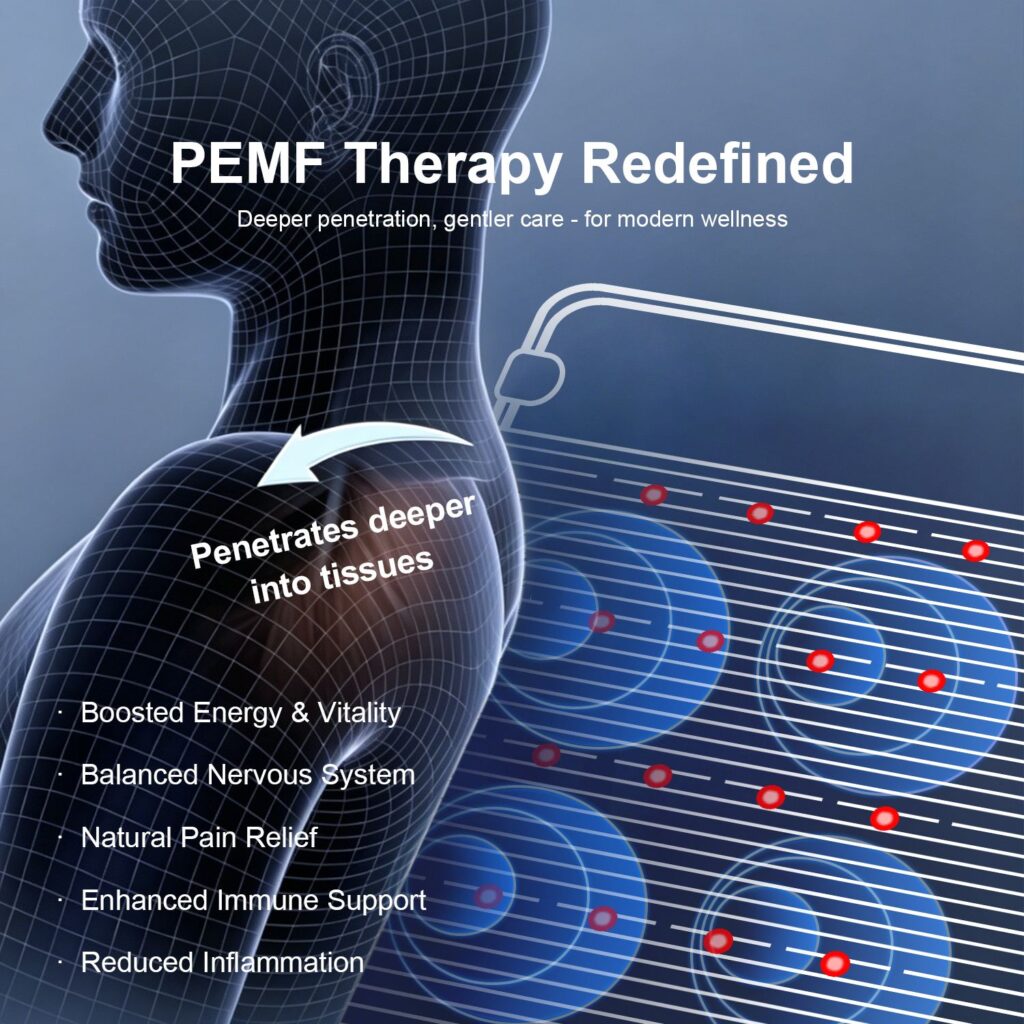
Quick Answer: What Is Pulsed Electromagnetic Field Therapy?
Pulsed electromagnetic field therapy (PEMF therapy) is a non-invasive technology that exposes a selected area of the body to controlled, time-varying electromagnetic fields.
A typical PEMF system uses an electronic signal generator and one or more electromagnetic coils. Electrical current flowing through a coil produces a magnetic field. By controlling the current over time, the system generates a pulsed or otherwise time-varying magnetic field.
Researchers have investigated pulsed electromagnetic field therapy in several areas, including osteoarthritis, musculoskeletal conditions, and bone-related applications. Some clinical studies report positive outcomes for specific conditions, while others show mixed or non-significant results.
The evidence must therefore be interpreted by condition, device, treatment protocol, outcome measure, and follow-up period. PEMF should not be described as a universal treatment or a replacement for established medical care.
Table of Contents
- What Is Pulsed Electromagnetic Field Therapy?
- How Does PEMF Therapy Work?
- The Physics Behind Pulsed Electromagnetic Fields
- Types of PEMF Devices and Applicators
- Important PEMF Treatment Parameters
- What Does Clinical Research Show?
- How Are PEMF Devices Tested?
- How to Evaluate PEMF Device Quality
- Safety and Regulatory Considerations
- Frequently Asked Questions
- Conclusion
- References
1. What Is Pulsed Electromagnetic Field Therapy?
Pulsed electromagnetic field therapy is a method of applying controlled electromagnetic fields that vary over time.
Unlike a static magnet, which produces a relatively constant magnetic field, a PEMF device uses electronic circuitry to generate a changing magnetic field through one or more coils.
A typical system contains five main components:
- Signal generator: Produces the electrical waveform.
- Power driver: Supplies the required current to the coil.
- Electromagnetic coil: Converts electrical current into a magnetic field.
- Control system: Sets operating parameters such as frequency, pulse duration, and output level.
- Power supply: Provides electrical energy to the system.
The resulting magnetic field depends on the coil design, number of turns, electrical current, waveform, operating frequency, and measurement position.
1.1 PEMF Therapy vs. Static Magnetic Fields
| Characteristic | Static Magnetic Field | Pulsed Electromagnetic Field |
|---|---|---|
| Field behavior | Relatively constant | Changes over time |
| Electronic control | Not necessarily required | Usually required |
| Frequency | 0 Hz for a static field | Defined by the signal |
| Pulse duration | Not applicable | Can be controlled |
| Waveform | Constant field | May be square, sinusoidal, triangular, or another shape |
| Main engineering variables | Field magnitude and spatial distribution | Field magnitude, waveform, frequency, pulse width, and spatial distribution |
A PEMF device cannot be fully characterized by a single magnetic field strength or frequency value. Its complete signal and field distribution should be considered.
1.2 What Is the Purpose of PEMF Research?
Research into pulsed electromagnetic field therapy generally investigates two different questions:
- Biological research: How do controlled electromagnetic exposures interact with cells, tissues, or biological processes?
- Clinical research: Do specific PEMF devices and treatment protocols produce measurable changes in defined patient outcomes?
These questions require different research methods. Laboratory findings do not automatically establish clinical effectiveness.
2. How Does PEMF Therapy Work?
The physical principle behind PEMF devices is electromagnetic induction.
When the magnetic field generated by a coil changes over time, it can induce an electric field in nearby conductive materials. Biological tissues contain water and dissolved ions, so researchers study whether and how electromagnetic exposure may influence biological processes.
Several mechanisms have been investigated, including:
- Calcium-related cellular signaling
- Cell membrane-associated processes
- Inflammatory signaling pathways
- Cell proliferation and differentiation
- Bone and cartilage cell responses
These are research topics rather than universal or fully established explanations for clinical outcomes.
2.1 Electromagnetic Induction
Faraday’s law describes the relationship between changing magnetic flux and induced electromotive force.
Faraday’s law of electromagnetic induction
Where:
- ℰ = induced electromotive force
- N = number of coil turns
- ΦB = magnetic flux through one turn
- t = time
This equation describes a physical induction principle. It does not establish a specific biological response or therapeutic benefit.
2.2 Biological Research and Clinical Evidence Are Different
| Research Type | Typical Method | Main Research Question |
|---|---|---|
| In vitro research | Cell culture experiments | Are there measurable cellular responses? |
| Preclinical research | Animal models | Are responses observed in living biological systems? |
| Clinical research | Human trials | Are there measurable outcomes in a defined patient population? |
| Systematic review | Structured evidence synthesis | What does the available body of research indicate? |
A reliable interpretation of pulsed electromagnetic field therapy should distinguish these evidence levels.
3. The Physics Behind Pulsed Electromagnetic Fields
Understanding the physical characteristics of a PEMF signal is essential for comparing devices and reproducing research protocols.
3.1 Magnetic Flux Density
Magnetic flux density is commonly used to describe the magnitude of a magnetic field. It is measured in tesla (T).
Common units include:
| Unit | Equivalent |
|---|---|
| 1 tesla (T) | 1,000 millitesla |
| 1 millitesla (mT) | 1,000 microtesla |
| 1 microtesla (µT) | 0.001 millitesla |
| 1 gauss (G) | 100 microtesla |
A measurement should specify whether it represents peak, peak-to-peak, or RMS magnitude. The measurement position and probe orientation should also be documented.
3.2 Magnetic Field Generated by a Coil
For an ideal, sufficiently long solenoid, the approximate magnetic flux density inside the coil is:
Approximate magnetic flux density inside an ideal long solenoid
Where:
- B = magnetic flux density
- μ0 = permeability of free space
- μr = relative permeability of the core material
- n = number of coil turns per unit length
- I = electrical current
This is an idealized engineering approximation. Real PEMF coils have finite dimensions, and their field distributions must be measured or calculated using an appropriate model.
3.3 Frequency
Frequency describes how often a periodic signal repeats.
It is measured in hertz (Hz).
A frequency specification alone does not describe the complete electromagnetic exposure. Two devices operating at the same frequency may have different magnetic field amplitudes, waveforms, pulse widths, and spatial distributions.
3.4 Waveform
Common signal configurations include:
- Square wave
- Sinusoidal wave
- Triangular wave
- Biphasic pulse
- Damped or exponentially decaying pulse
The waveform affects the rate of change of the magnetic field and can influence the induced electric field.
3.5 Pulse Width and Duty Cycle
Pulse width is the duration of an individual pulse.
Duty cycle describes the percentage of a defined period during which the signal is active.
Duty cycle calculation
Where:
- D = duty cycle
- Ton = signal-on duration
- Tperiod = total period
For example, if a signal is active for 2 milliseconds during a 10-millisecond period, its duty cycle is 20%.
This calculation applies to a periodic on/off signal with clearly defined active and inactive intervals. Other waveform designs may require different descriptions.
4. Types of PEMF Devices and Applicators
Pulsed electromagnetic field therapy systems use different coil configurations depending on the intended exposure area and engineering design.
4.1 Solenoid Coils
A solenoid consists of wire windings arranged around a cylindrical or similar core structure.
Its magnetic field is influenced by:
- Number of turns
- Coil length and diameter
- Current
- Core material
- Operating waveform
Solenoid coils are commonly studied in electromagnetic field generation and laboratory applications.
4.2 Flat Spiral Coils
Flat spiral coils use windings arranged in a planar configuration.
They can be incorporated into compact applicators or larger flexible systems. Their magnetic field distribution varies with coil diameter, winding geometry, current, and distance from the coil.
4.3 Helmholtz Coil Pairs
A Helmholtz configuration uses two matched circular coils arranged on a common axis with a defined separation.
This arrangement can produce a relatively uniform magnetic field near the center of the coil pair under idealized conditions.
It is useful in laboratory settings where controlled field exposure is required.
4.4 Multi-Coil Arrays
A multi-coil system uses several coils arranged across a larger area.
The engineering challenge is not simply the number of coils. It also includes:
- Coil spacing
- Relative orientation
- Current distribution
- Electrical synchronization
- Magnetic field overlap
- Spatial uniformity
4.5 PEMF Mats
A PEMF mat generally integrates multiple coils into a flexible or semi-rigid platform.
Its performance depends on the coil arrangement, electrical driving system, magnetic field distribution, and operating conditions.
A mat with many coils does not necessarily produce a uniform field. Measurements should be made across the actual usable surface.
4.6 Comparison of PEMF Device Configurations
| Device Configuration | Typical Structure | Important Engineering Consideration |
|---|---|---|
| Single-coil applicator | One coil | Field strength and spatial distribution |
| Solenoid system | Cylindrical winding | Axial field characteristics |
| Flat coil | Planar winding | Field variation with distance |
| Helmholtz pair | Two matched coils | Central field uniformity |
| Multi-coil mat | Distributed coils | Coil interaction and coverage |
Device architecture alone does not establish clinical superiority. Clinical evidence must be linked to the specific device and treatment protocol studied.
5. Important PEMF Treatment Parameters
A scientific report on pulsed electromagnetic field therapy should describe the electromagnetic exposure in sufficient detail for comparison and replication.
| Parameter | Unit | What It Describes |
|---|---|---|
| Magnetic flux density | T, mT, µT, G | Magnetic field magnitude |
| Frequency | Hz | Repetition rate |
| Pulse width | µs, ms | Duration of an individual pulse |
| Duty cycle | % | Active time within a defined period |
| Waveform | Shape | Signal structure |
| Exposure duration | Minutes | Total time per session |
| Coil distance | mm, cm | Distance from the coil to the measurement or exposure point |
| Spatial uniformity | % or variation | Consistency across a defined area |
5.1 Why Frequency Alone Is Not Enough
A device advertised with a particular frequency does not provide enough information to determine its complete electromagnetic output.
For a meaningful comparison, the following should also be reported:
- Magnetic flux density
- Waveform
- Pulse width
- Duty cycle
- Exposure duration
- Coil configuration
- Measurement position
5.2 Why Device Parameters Should Not Be Treated as Universal Treatment Recommendations
Research protocols differ considerably.
A parameter used in one clinical trial should not automatically be recommended for another condition or another device.
Clinical treatment protocols require appropriate evidence for the relevant population and intended use. Engineering specifications describe device output; they do not independently establish a therapeutic dose.
6. What Does Clinical Research Show?
Clinical studies have investigated pulsed electromagnetic field therapy in several musculoskeletal conditions.
The following examples illustrate both positive findings and important limitations. They should not be interpreted as proof that all PEMF devices produce the same results.
6.1 Osteoarthritis: 2020 Systematic Review and Meta-Analysis
Yang et al. published a systematic review and meta-analysis of randomized placebo-controlled trials in Physical Therapy in 2020.
The review included:
- 16 studies in the systematic review
- 15 studies in the meta-analysis
- 1,078 participants across the 16 studies
The authors reported the following standardized mean differences:
| Outcome | Standardized Mean Difference | 95% Confidence Interval |
|---|---|---|
| Pain | 1.06 | 0.61 to 1.51 |
| Stiffness | 0.37 | 0.07 to 0.67 |
| Physical function | 0.46 | 0.14 to 0.78 |
| Quality of life | 1.49 | -0.06 to 3.04 |
The authors reported beneficial pooled effects for pain, stiffness, and physical function compared with placebo. The quality-of-life estimate was not statistically significant because its confidence interval included zero.
The authors also noted that the available evidence was limited to short-term effects and that further studies were needed to confirm quality-of-life outcomes.
Interpretation: This review provides evidence of potential short-term benefits in osteoarthritis populations. It does not establish long-term effectiveness or demonstrate that every PEMF device and protocol produces equivalent results.
6.2 Shoulder Impingement Syndrome: 2025 Meta-Analysis
Wang et al. published a systematic review and meta-analysis in PLOS ONE in May 2025.
The study included:
- 4 randomized controlled trials
- 252 participants
The authors reported the following pooled results:
| Outcome | Standardized Mean Difference | 95% Confidence Interval | Trials / Participants |
|---|---|---|---|
| Short-term pain | -0.34 | -0.66 to -0.01 | 3 / 166 |
| Short-term function | 0.40 | 0.08 to 0.73 | 3 / 166 |
| Long-term function | 0.60 | 0.33 to 0.88 | 3 / 212 |
The negative value for short-term pain reflects the direction of the pain outcome in the authors’ analysis. Functional outcomes were reported in the positive direction.
The authors reported statistically significant pooled findings, but also identified limitations including a small number of trials and variation in PEMF treatment protocols.
Interpretation: These results relate specifically to the shoulder impingement populations and interventions included in the review. They should not be generalized to all shoulder conditions or other diagnoses.
6.3 Knee Osteoarthritis: 2026 Systematic Review and Meta-Analysis
Chang, Lin, and Huang published a systematic review and meta-analysis in Medicina in April 2026.
The review included:
- 9 randomized controlled trials
- 457 participants
- Trials published between 2015 and 2025
The authors reported time-dependent results:
| Outcome | Reported Mean Difference | 95% Confidence Interval | Assessment |
|---|---|---|---|
| WOMAC pain | -1.63 | -2.43 to -0.82 | 18–21 days |
| WOMAC stiffness | -1.11 | -1.386 to -0.85 | 1 month |
| WOMAC daily activity | -3.39 | -4.81 to -1.97 | 1 month |
Importantly, the review found no significant improvement in VAS pain or total WOMAC scores at one month. Objective functional measures also did not show significant improvement.
The authors reported a high overall risk of bias across the included studies and noted that some statistically significant changes might not reach thresholds for clinical meaningfulness.
Interpretation: The findings are outcome- and time-dependent. They do not support a broad claim that PEMF consistently improves all knee osteoarthritis symptoms or functional measures.
6.4 Comparison of the Three Reviews
| Publication | Condition | Evidence Base | Main Interpretation |
|---|---|---|---|
| Yang et al., 2020 | Osteoarthritis | 16 studies; 1,078 participants | Positive pooled results for several short-term outcomes; quality-of-life result uncertain |
| Wang et al., 2025 | Shoulder impingement | 4 RCTs; 252 participants | Positive pooled findings for selected pain and function outcomes; limited trial base |
| Chang et al., 2026 | Knee osteoarthritis | 9 RCTs; 457 participants | Mixed, time-dependent findings; no significant improvement in several overall or objective outcomes |
These studies should not be combined into a single numerical effectiveness score. They investigate different conditions, outcomes, and treatment protocols.
6.5 What Are the Main Limitations of Current Clinical Evidence?
Several issues make it difficult to compare PEMF studies directly:
- Different treatment parameters: Frequency, field amplitude, waveform, and exposure duration vary.
- Different clinical populations: Results from one diagnosis cannot be assumed to apply to another.
- Different outcome measures: Studies use different pain and functional assessment scales.
- Small trial samples: Some clinical studies include relatively few participants.
- Follow-up limitations: Short-term improvements do not establish long-term outcomes.
- Risk of bias: Study design and reporting quality can affect confidence in pooled results.
- Clinical significance: Statistical significance does not necessarily mean that a change is meaningful to patients.
A balanced interpretation should report both positive and non-significant findings.
7. How Are PEMF Devices Tested?
Clinical trials evaluate outcomes in people. Engineering tests evaluate whether a device produces its intended electromagnetic output.
These are complementary but distinct forms of evidence.
A device may generate the expected electrical waveform while producing a non-uniform magnetic field. A coil may also produce a measurable field while its output changes during extended operation.
A complete engineering evaluation should therefore include electrical, magnetic, thermal, and reliability measurements.
7.1 Magnetic Field Strength Testing
A calibrated gaussmeter or suitable magnetic field probe can be used to measure magnetic flux density.
A test report should specify:
- Instrument manufacturer and model
- Probe type and measurement range
- Calibration status
- Probe orientation
- Measurement distance
- Measurement location
- Device operating mode
- Sampling method
- Measurement uncertainty
Measurements should be taken at defined positions across the intended exposure area, not only directly on the coil.
7.2 Frequency Testing
Frequency can be measured using an oscilloscope, frequency counter, or suitable data acquisition system.
The measured frequency should be compared with the programmed value.
Testing should also evaluate frequency stability over time and under different operating conditions.
7.3 Waveform Testing
An oscilloscope can be used to examine:
- Pulse shape
- Rise time
- Fall time
- Pulse width
- Repetition period
- Overshoot
- Ringing
- Signal distortion
The electrical signal supplied to the coil and the resulting magnetic waveform should not be assumed to be identical. Where possible, both should be measured.
7.4 Spatial Uniformity Testing
For PEMF mats and multi-coil systems, spatial uniformity is an important engineering characteristic.
A measurement grid can be defined across the usable exposure surface. The magnetic field should be measured at each grid point under identical operating conditions.
The coefficient of variation can be used as a descriptive statistic.
Coefficient of variation of magnetic field measurements
Where:
- CV = coefficient of variation
- σ = standard deviation of measured magnetic flux density
- B̄ = mean magnetic flux density
A lower CV indicates less relative variation among the sampled measurement points.
However, CV alone does not establish that a magnetic field is clinically appropriate. Acceptable limits must be defined according to the device’s engineering specifications and intended use.
7.5 Thermal Testing
Electrical current flowing through coils and power electronics can generate heat.
Thermal testing should examine:
- Coil surface temperature
- Driver circuit temperature
- Power supply temperature
- Temperature rise over time
- Performance under repeated operation
- Performance under maximum intended output conditions
Testing should be performed under defined environmental and operating conditions.
7.6 Electrical Safety and Reliability Testing
Depending on the device classification and intended market, an evaluation may include:
- Insulation resistance
- Leakage current
- Dielectric strength
- Protective earth continuity
- Overcurrent protection
- Overtemperature protection
- Electromagnetic compatibility
- Long-duration output stability
The applicable test standards depend on the product design, classification, and regulatory requirements.
7.7 Example PEMF Engineering Test Matrix
| Test Category | Instrument or Method | Main Measurement |
|---|---|---|
| Magnetic field | Gaussmeter / magnetic probe | Magnetic flux density |
| Frequency | Oscilloscope / frequency counter | Repetition frequency |
| Waveform | Oscilloscope | Pulse shape and timing |
| Pulse width | Oscilloscope | Pulse duration |
| Spatial uniformity | Defined measurement grid | Field variation |
| Thermal performance | Temperature sensors / thermal camera | Temperature rise |
| Electrical safety | Applicable safety test equipment | Electrical protection |
| Reliability | Extended operating test | Output stability |
A testing matrix is a framework for engineering evaluation, not a claim that a particular device has passed certification.
8. How to Evaluate PEMF Device Quality
A useful evaluation should combine technical specifications, reproducible measurements, and transparent reporting.
8.1 Report the Actual Magnetic Field
A single peak field value is insufficient to characterize a PEMF mat or multi-coil device.
A more complete report should include:
- Field strength at the center
- Field strength at the edges
- Field strength at representative exposure locations
- Measurement distance
- Field direction
- Operating mode
- Measurement uncertainty
8.2 Understand Multiple-Coil Interaction
In a multi-coil system, the total magnetic field is the vector sum of the fields generated by the individual coils.
Vector sum of magnetic fields generated by multiple coils
For clarity, the vector form is:
Vector addition of the magnetic fields from n coils
The direction of each field matters. Simply adding the peak magnitudes of individual coils may not accurately describe the resulting field.
8.3 Require Reproducible Test Reports
A useful test report should include:
- Device model and serial number
- Coil configuration
- Operating mode
- Test environment
- Measurement equipment
- Calibration information
- Measurement locations
- Raw or processed measurement data
- Test date and operator
Manufacturer specifications should be clearly distinguished from independently measured results.
8.4 Example Device Performance Report
| Test Item | Reported Result | Required Test Information |
|---|---|---|
| Magnetic flux density | Actual measured value | Distance, position, and probe orientation |
| Frequency | Actual measured value | Operating mode and sampling method |
| Pulse width | Actual measured value | Waveform and measurement method |
| Duty cycle | Actual measured value | Defined signal period |
| Field uniformity | Calculated value | Measurement grid and statistical method |
| Maximum temperature | Actual measured value | Operating duration and ambient conditions |
Do not publish example numbers as actual product test results. Only enter values supported by measurements.
9. Safety and Regulatory Considerations
The safety and regulatory status of pulsed electromagnetic field therapy depends on the specific device, its output characteristics, intended use, and applicable jurisdiction.
Safety considerations may include:
- Implanted electronic medical devices
- Pregnancy
- Device-specific contraindications
- Electrical safety
- Thermal performance
- Use outside manufacturer instructions
People with implanted electronic devices, such as pacemakers or neurostimulators, should consult their healthcare professional and follow the relevant device manufacturers’ instructions before exposure to electromagnetic equipment.
9.1 Regulatory Status Is Device-Specific
Regulatory clearance or approval applies to a specific product and its authorized intended use. It should not be generalized to every PEMF device.
For example, in the United States, FDA clearance and FDA approval are different regulatory pathways. A company should not use either term unless it can document the exact product, regulatory status, and applicable indication.
9.2 Responsible Health Communication
Avoid unsupported statements such as:
- “PEMF therapy cures arthritis.”
- “PEMF guarantees pain relief.”
- “All PEMF frequencies regenerate cells.”
- “PEMF repairs every type of tissue.”
- “PEMF replaces conventional medical treatment.”
More accurate statements describe the condition studied, the intervention used, the reported outcome, and the limitations of the evidence.
10. Frequently Asked Questions
What does pulsed electromagnetic field therapy mean?
Pulsed electromagnetic field therapy refers to the application of controlled electromagnetic fields that vary over time. These fields are typically generated by electrical current flowing through one or more coils.
Is pulsed electromagnetic field therapy scientifically proven?
PEMF has been studied in laboratory experiments, preclinical research, and clinical trials. Some systematic reviews report positive findings for specific conditions and outcomes. Other results are mixed or non-significant. The evidence should be evaluated separately for each condition and device.
What is the difference between PEMF therapy and static magnets?
Static magnets produce relatively constant magnetic fields. PEMF systems generate time-varying magnetic fields through electronically controlled coils.
Does PEMF frequency determine treatment effectiveness?
No single frequency value determines clinical effectiveness. Magnetic field strength, waveform, pulse width, exposure duration, coil geometry, and the studied condition are also relevant.
Are all PEMF devices the same?
No. Devices can differ in coil structure, output waveform, frequency, magnetic field strength, control electronics, and field uniformity. Their actual output should be measured rather than inferred from marketing specifications.
How is the magnetic field of a PEMF device measured?
A calibrated gaussmeter or suitable magnetic field probe can measure magnetic flux density. Measurements should be performed at defined distances and locations while the device operates under specified conditions.
What is the difference between a PEMF coil and a PEMF mat?
A PEMF coil is an electromagnetic component that generates a magnetic field. A PEMF mat generally integrates multiple coils into a larger platform. The number and arrangement of coils influence the field distribution, but do not independently establish clinical effectiveness.
Can PEMF therapy replace medical treatment?
PEMF should not be presented as a substitute for established medical diagnosis or treatment. People with medical concerns should consult an appropriately qualified healthcare professional.
What should a PEMF device test report include?
A useful report should include magnetic field measurements, frequency, waveform, pulse width, spatial distribution, operating conditions, measurement instruments, calibration information, and relevant safety testing.
11. Conclusion
Pulsed electromagnetic field therapy is an important subject in electromagnetic engineering and biomedical research.
Its scientific evaluation requires more than a frequency setting or a headline magnetic field value. Researchers and manufacturers should consider waveform characteristics, magnetic field distribution, coil design, exposure conditions, measurement reproducibility, and safety.
Clinical research has reported positive findings in certain musculoskeletal conditions, including osteoarthritis and shoulder impingement syndrome. However, the evidence also contains mixed outcomes, limited follow-up, small trial samples, and differences in study quality.
A responsible approach to PEMF research and device evaluation should combine:
- Clearly documented technical specifications
- Reproducible electromagnetic field measurements
- Appropriate laboratory and engineering testing
- Well-designed clinical studies
- Transparent reporting of positive and non-significant findings
- Accurate communication of regulatory status and evidence limitations
Further standardized research is needed to determine which devices, exposure parameters, and treatment protocols may be relevant to specific clinical applications.
12. References
- Yang X, He H, Ye W, Perry TA, He C. (2020). Effects of Pulsed Electromagnetic Field Therapy on Pain, Stiffness, Physical Function, and Quality of Life in Patients With Osteoarthritis: A Systematic Review and Meta-Analysis of Randomized Placebo-Controlled Trials. Physical Therapy, 100(7), 1118–1131.
https://doi.org/10.1093/ptj/pzaa054 - Wang H-Y, Chen Y-J, Huang I-C, Lin C-R, Lin K-L, Chen C-H. (2025). The effectiveness of pulsed electromagnetic field therapy in patients with shoulder impingement syndrome: A systematic review and meta-analysis of randomized controlled trials. PLOS ONE, 20(5), e0323837.
https://doi.org/10.1371/journal.pone.0323837 - Chang Y-S, Lin C-Y, Huang W-C. (2026). Pulsed Electromagnetic Field Therapy in People with Knee Osteoarthritis: A Systematic Review and Meta-Analysis. Medicina, 62(4), 677.
https://doi.org/10.3390/medicina62040677
Suggested Internal Links
For a PEMF technology and research website, consider linking to related technical resources:
- PEMF Coils: Design, Types, and Magnetic Field Characteristics
- PEMF Mat: Coil Configuration and Field Distribution
- PEMF Frequency: Understanding Electromagnetic Signal Parameters
- PEMF Testing: Magnetic Field Measurement and Quality Control
- PEMF Safety: Technical and Regulatory Considerations
Use descriptive anchor text and link only to pages that provide genuinely relevant additional information.